



By Dr. Ananya Sharma, Ph.D. Environmental Science (Air Pollution & Urban Air Quality) · Last updated: October 10, 2026
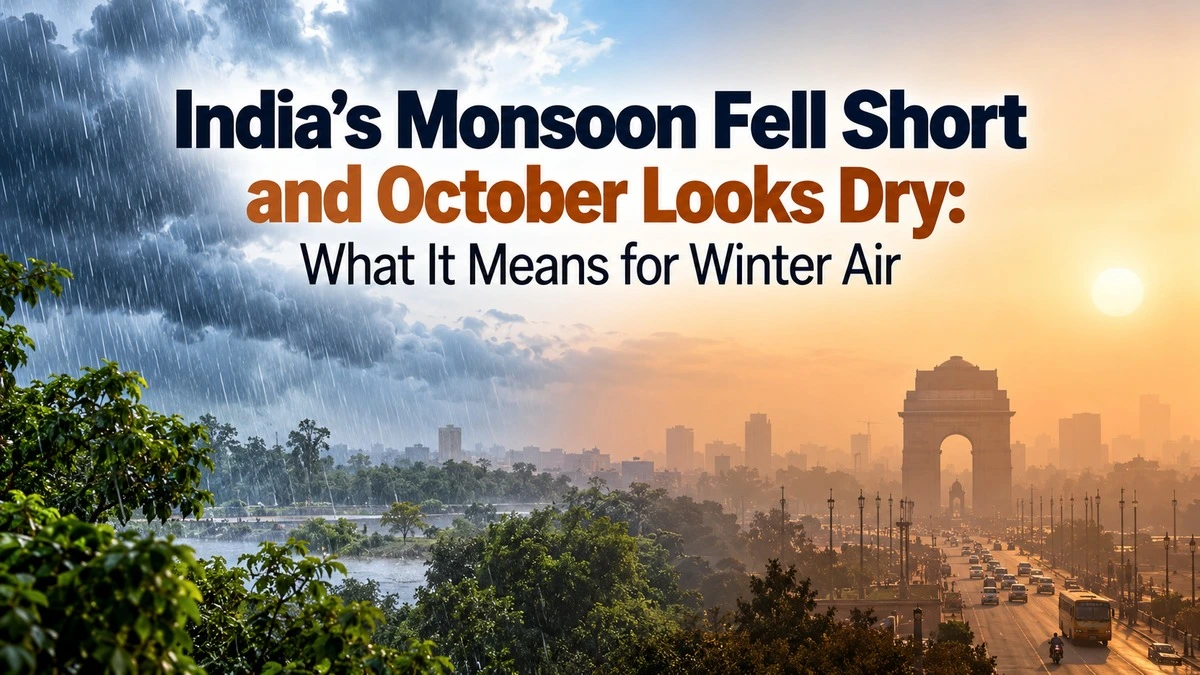
India’s monsoon has finished well short of normal, and the weather office expects October to stay drier and warmer than usual across most of the country. That’s not an air-quality forecast. But rain is the cleanest thing nature offers a city, so a dry autumn is worth understanding before winter smog season sets in.
What the India Meteorological Department reported
According to figures reported from the India Meteorological Department (IMD) on October 1, the June-to-September monsoon delivered 759.4 mm of rain, or 87% of the long-period average. That’s the fourth-lowest monsoon total since 2001. Seventeen of the country’s 36 meteorological subdivisions, covering about 42% of its area, ended the season deficient. Only Odisha recorded excess rain.
The month-by-month picture was uneven: June came in at 65% of normal, July at 101%, August at 84% and September at 92%.
For October, IMD expects below-normal rain across most of India, with the monthly total likely under 85% of average. Daytime and night-time temperatures are both expected to run above normal in most regions. Parts of northwest India, the southern peninsula and a few eastern areas may still see normal or above-normal rain, and IMD has also flagged an active western disturbance affecting northwest India in the first week of the month.
Why rain matters for the air you breathe
Think of rain as a free street-sweeper. Each shower knocks dust and fine particles out of the air and onto the ground. When showers stop, those particles stay airborne longer and pile up with whatever the city adds each day: vehicle exhaust, construction dust, and, from October, smoke drifting in from farm fires.
Delhi already shows the pattern. The first week of October averaged an AQI of 171, the worst start to October in three years, according to CPCB data reported by ThePrint, with PM10 the prominent pollutant on the worst day. That fits a dry, dusty start to the month, though a single week can’t prove a trend.
What this does and doesn’t tell us
- It isn’t a smog forecast. IMD’s outlook covers rain and temperature only. Linking it to air quality is our reading of how the weather works, not an IMD claim.
- Warm doesn’t mean clean. Warmer nights can sometimes keep air a little more mixed than a cold, still morning would. But winds, farm-fire smoke and local emissions usually matter more.
- Western disturbances are the wild card. One good spell of rain can cut pollution for a few days, It rarely changes the season.
- The bigger climate backdrop. IMD’s seasonal outlook says El Niño is likely to keep strengthening through the end of the year. Its updated outlook for November is due toward the end of October, and that’s worth watching.
What this means for you
- If you live in north India, treat the dry weeks ahead as the time to prepare, not the time to relax. Check your air purifier filters and stock masks now.
- Look at PM2.5 and PM10 separately. Dry, dusty days often push PM10 up first.
- Check the CPCB’s official AQI bulletin each morning, and plan outdoor exercise for the cleanest hours of the day.
- Don’t read one rainy day as the all-clear. Watch the three-day forecast instead.
Charts worth building
A simple bar chart of monthly monsoon rainfall against 100% of normal would show how June’s weak start shaped the season. A line chart of Delhi’s daily AQI from September 25 to today, marking each rain day, would show how quickly air clears and rebuilds.
The bottom line
A weak monsoon and a dry October mean fewer natural clean-ups before winter. Preparing early costs little, and it’s the part of the story you can control.
Related reading: Why rain from a western disturbance can’t clear Delhi’s air for long; how to read India’s AQI categories; N95 vs surgical vs cloth masks.
Sources
- India Meteorological Department (IMD) – Press Release on Post-Monsoon Season Outlook, September 30, 2026
- The Bridge Chronicle – India records fourth-lowest southwest monsoon rainfall since 2001 (reporting IMD figures)
- ThePrint – Delhi’s October first-week AQI
- Central Pollution Control Board (CPCB) – National Air Quality Index
This article was researched and fact-checked against official and primary sources, then reviewed by our editorial team. We update posts when new data is published.


