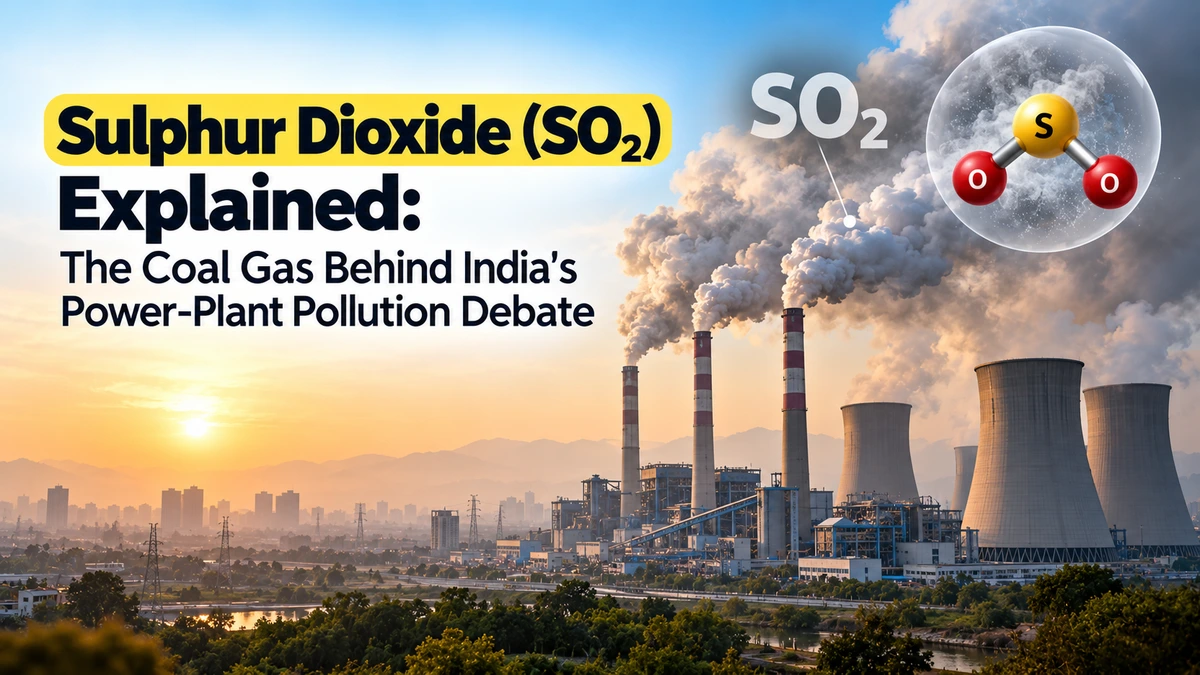
Sulphur dioxide, or SO2, rarely makes headlines the way PM2.5 does. Yet it’s central to one of India’s live debates: whether coal power plants should be forced to fit expensive equipment to scrub it from their smokestacks. Here’s what the gas is, what it does and why people disagree.
What SO2 is
SO2 is a colourless gas with a sharp, burnt-match smell. It forms when fuels containing sulphur are burned. Coal is the biggest source in many countries, and some diesel and industrial processes add to it. Cleaner fuels such as natural gas contain far less sulphur.
What it does to you
SO2 irritates the nose, throat and airways. People with asthma feel it first, often as wheezing or a tight chest, and those effects can start within minutes of exposure. Children and older adults are also more vulnerable.
It has a second, quieter effect. In the air, SO2 slowly turns into tiny sulphate particles, which count as PM2.5. So a coal plant’s SO2 can end up as fine dust in a city far from the chimney, which is why scientists treat it as a PM2.5 ingredient and not just a gas.
What the limits say
- India’s national ambient air quality standards (2009) set the SO2 limit at 80 µg/m³ over 24 hours and 50 µg/m³ over a year.
- The World Health Organization’s 2021 guideline is stricter for daily exposure: 40 µg/m³ over 24 hours.
Why India is arguing about it
In December 2015, India set SO2 emission norms for coal power plants, which would require flue-gas desulphurisation (FGD) units. These work like a giant chimney filter: the exhaust is sprayed with a limestone mixture that captures the sulphur. The deadlines were pushed back several times.
On July 11, 2025, the environment ministry eased the rules again. Plants within 10 km of the National Capital Region or cities with over one million people (Category A) must comply by December 2027. Plants near critically polluted or non-attainment cities (Category B) are assessed case by case. Plants elsewhere (Category C) are exempt from mandatory SO2 compliance, subject to other pollution norms.
The two sides
- Supporters of the easing point to an IIT Delhi study stating that SO2 from coal-plant stacks has no significant impact on ambient air quality beyond a 60 km radius, and to a CSIR-NEERI analysis of monitoring stations finding few sites over the limit. Reporting notes that the NEERI report hasn’t been made public.
- Critics say SO2 turns into PM2.5, so monitoring the gas alone understates its health effect, and that a study cited in a CPCB tribunal reply claims power plants in Delhi-NCR emit far more SO2 than stubble burning does.
What this means for you
- Your AQI app may not show SO2 prominently, because it usually reports whichever pollutant is highest. Check whether your local monitor lists it.
- If you live near a coal plant or heavy industry and have asthma, watch for wheezing on days with low wind, when emissions linger.
- An air purifier with a HEPA filter catches particles, including sulphates, but not the SO2 gas itself.
Data visualization idea
A map of India’s coal plants coloured by their July 2025 category (A, B or C), overlaid with CPCB’s SO2 monitoring stations, would show at a glance which regions are covered by mandatory scrubbing and which aren’t.
Bottom line
SO2 is a smaller problem than PM2.5 at most monitors, but it’s also a building block of PM2.5. Whether India’s easing of the FGD rules is safe depends on data that’s still being debated.
Related reading
- Nitrogen dioxide (NO2) explained: the traffic gas hiding behind your AQI
- Ground-level ozone: why air can be unhealthy on clear, sunny days
- Delhi-NCR’s new industrial dust limit: what changes
Sources
- The Week (PTI): Centre eases SO2 emission norms, exempts large number of coal plants, July 12, 2025
- Down To Earth: Where is India’s SO2 control from TPPs headed?
- Central Pollution Control Board (CPCB): National Ambient Air Quality Standards
- World Health Organization: Global air quality guidelines, 2021
Written by Arjun Mehta, M.Tech. Environmental Engineering, specialising in air quality monitoring and emission control. Researched and fact-checked against primary and official sources, and reviewed by the AQI World editorial team. Last updated: October 13, 2026.