By Dr. Lukas Müller, Ph.D. Atmospheric Sciences — Atmospheric Chemistry & Air Pollution. Last updated: September 17, 2026.
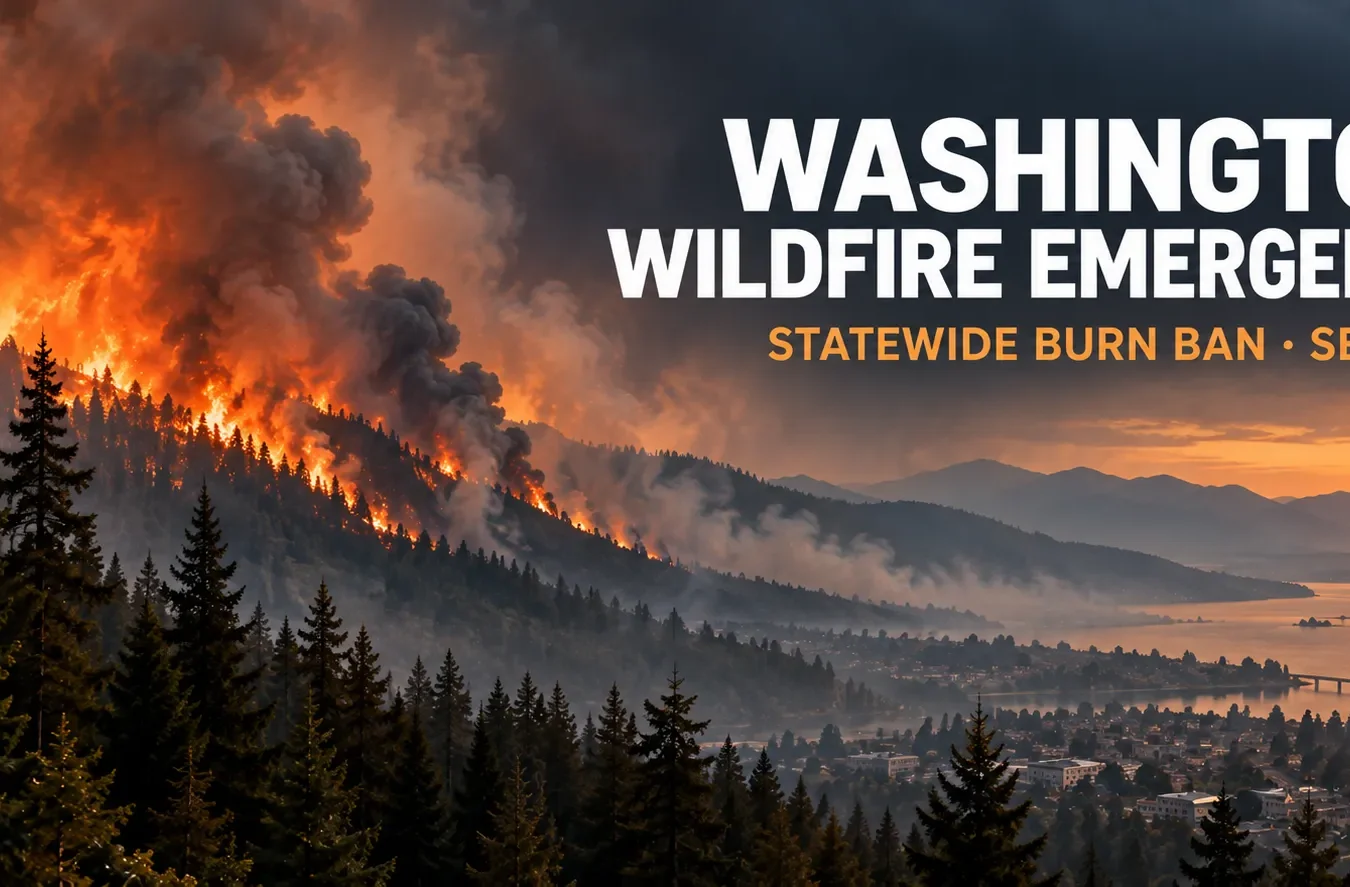
Washington Governor Bob Ferguson has declared a statewide wildfire emergency and extended an emergency burn ban across the state through noon on September 30, 2026. More than 1,000 wildfires have burned roughly 425,000 acres this year — the highest annual total since 2021 — and the smoke they produce is affecting air quality well beyond the fire lines.
What’s happening
The burn ban covers yard debris burning, trash disposal fires, land clearing, weed abatement, bonfires, and campfires not contained in a proper fire ring or structure. It’s a blanket measure meant to stop new ignitions while firefighters are stretched thin across Central Washington and other hard-hit regions. Hundreds of structures have burned, and officials are describing current conditions as among the most dangerous fire years the state has seen in decades.
Smoke isn’t staying local. Plumes from Central Washington fires are mixing with smoke drifting south from British Columbia, layering multiple sources over the same communities. That combination has pushed particulate levels into unhealthy ranges in areas that, on a normal September day, would see clean air.
Why smoke travels so far
Wildfire smoke is mostly fine particulate matter (PM2.5) — particles small enough to ride wind currents for hundreds of miles before settling. How far and how badly it settles depends on the atmosphere above the fire: under a stable, high-pressure pattern, smoke can get trapped close to the ground where people breathe it; under different wind patterns, it lofts higher and travels farther before descending on a distant city. That’s why a fire burning in one region can put a city 200 miles away under an air quality advisory while the area right around the fire sees relatively cleaner air, and why forecasts can change quickly — a wind shift can clear a valley in hours or fill it in overnight.
What this means for you
If you’re anywhere in the Pacific Northwest, or in a region receiving transported smoke, a few practical points matter more than the daily headline number:
- Check hourly, not just daily, AQI readings — wildfire smoke can spike and clear within a single day.
- Treat “unhealthy for sensitive groups” as your cue to reduce outdoor exertion, not just “unhealthy” or above.
- Keep windows closed and run air conditioning on recirculate during active smoke events, if your system allows it.
- If you’re in an area covered by the burn ban, holding off on outdoor burning helps reduce local particulate on top of what’s already drifting in.
Two visuals worth picturing here: a bar chart of Washington’s annual acres burned from 2021 through 2026 would show just how far outside the norm this year sits, and a simple AQI trend line for a smoke-affected county across the burn-ban period would show how quickly conditions swing with the wind.
The takeaway
This isn’t a one-day spike — it’s a season-long emergency with a burn ban now running through the end of September. Anyone downwind, even hundreds of miles away, should expect more smoke days before conditions ease, and should treat real-time AQI data as more reliable than seasonal averages right now.
Related reading: how PM2.5 and PM10 differ in health impact, and why the same smoke event produces different AQI numbers depending on which country’s scale is used.
Sources: Washington Governor’s Office, Washington State Department of Ecology — wildfire smoke, Washington State Department of Ecology — burn bans, AirNow.gov wildfire and smoke map.
Researched and fact-checked using the primary sources above; reviewed by our editorial team for accuracy before publication.