



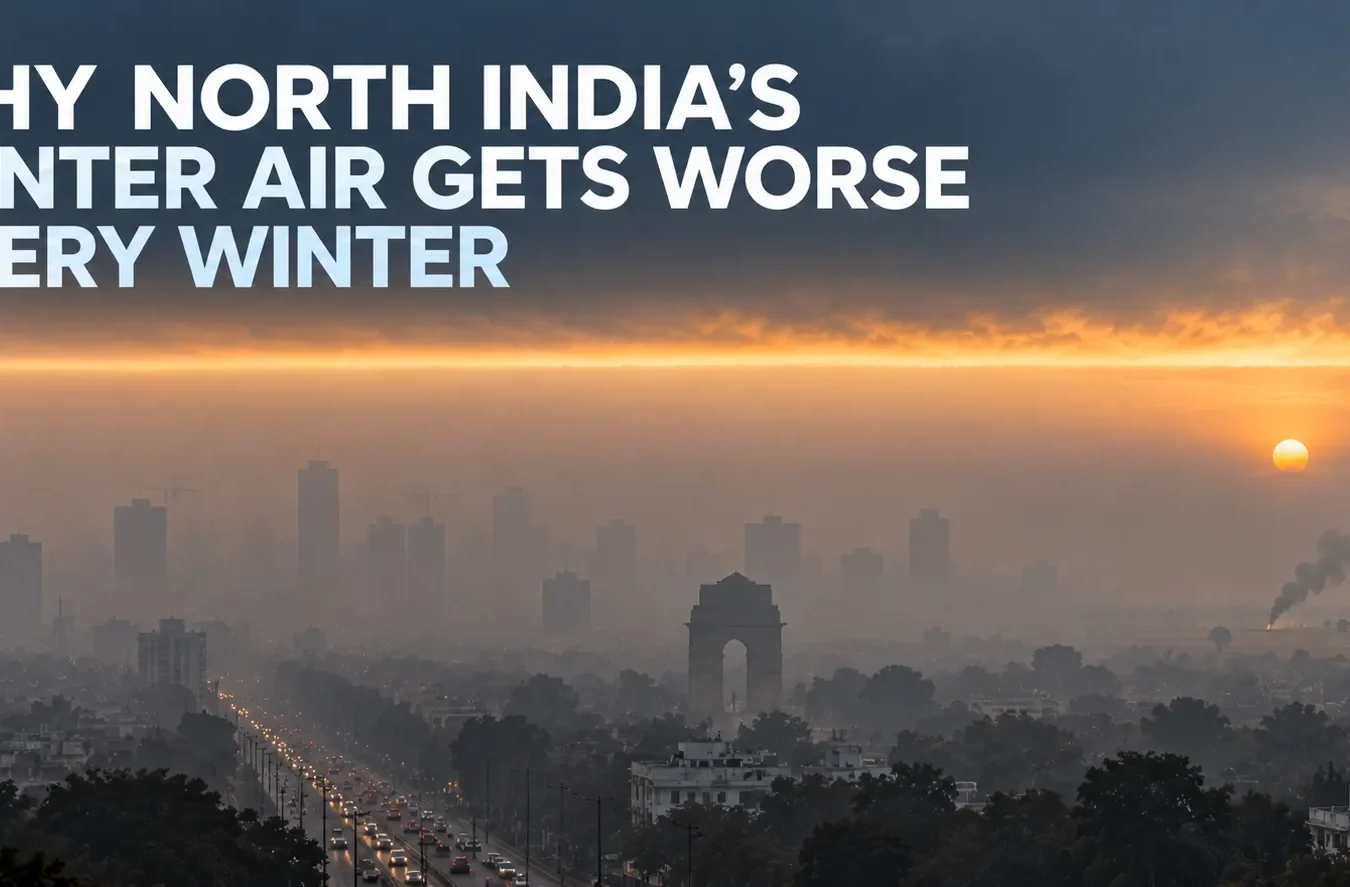
Every year around late October, headlines about Delhi’s air quality turn from bad to alarming almost overnight. Stubble burning in Punjab and Haryana usually gets the blame, and it’s a real contributor — but it’s not the whole story. The bigger factor is something far less visible: the air itself stops moving. Understanding why explains both the yearly spike and why it’s so hard to fix.
The fuel: paddy residue burning
After Punjab and Haryana’s rice harvest, farmers clear the leftover stubble from their fields, often by burning it, to get the ground ready for the next wheat crop before a narrow planting window closes. NASA’s Earth Observatory has tracked this fire activity by satellite for years and recently found something telling: the timing of the fires has shifted later in the day, from around 1:30 PM in 2020 to closer to 5 PM by 2024. That matters because the satellites government agencies rely on for official counts pass over the region only in the late morning — so a later burn means more fires go undercounted, even as the smoke still drifts toward Delhi overnight.
The trap: temperature inversion
Smoke alone doesn’t explain why the same fires produce a much worse haze in December than they would in July. The difference is a weather pattern called temperature inversion. Normally, air near the ground is warmer than the air above it, so it rises and carries pollution up and away. In winter, the ground cools faster than the air a few hundred meters up, flipping that order — warm air sits on top of cold air like a lid. Smoke, vehicle exhaust, and construction dust get trapped underneath it instead of dispersing, building up day after day.
Delhi’s geography makes this worse. The city sits in the Indo-Gangetic Plain, partly ringed by the Aravalli hills, which limits the wind flow that could otherwise clear the trapped air. Add in the season’s naturally lower wind speeds and reduced rainfall after the monsoon withdraws, and the same amount of pollution that would clear in hours during summer can sit over the city for days.
Why this year’s timing matters
This dynamic is exactly why India’s environment ministry runs seasonal reviews before winter arrives. In a mid-September 2026 meeting, the Union Environment Ministry and NCR states discussed the action plan for the upcoming season, covering dust control, industrial emissions monitoring, and stubble-burning coordination with Punjab and Haryana ahead of the Graded Response Action Plan (GRAP), which steps up restrictions automatically as AQI worsens. The goal is to have controls in place before the inversion season starts, not after.
What this means for you
- If you’re in Delhi-NCR, Punjab, or Haryana, expect AQI to climb from mid-October, independent of any single news event — it’s the seasonal pattern, not a one-off spike.
- A calm, hazy day is often worse than it looks, since low wind is precisely the condition that lets pollution accumulate under the inversion layer.
- Watch GRAP stage announcements, not just the raw AQI number — each stage brings specific restrictions (construction pauses, vehicle rules) that tell you how seriously authorities are treating that day’s air.
- N95/KN95 masks help on high-PM2.5 days; keeping windows closed during early morning and late evening — when inversions are strongest — reduces indoor exposure more than doing so at midday.
Data to watch
A simple cross-section diagram contrasting a normal day (warm air rising near the ground, pollution dispersing upward) against a winter inversion day (a warm “lid” trapping cool, polluted air near the surface).
A month-by-month line chart of Delhi’s average AQI across a full year, highlighting the October-January climb against the comparatively cleaner monsoon months.
None of this makes the smoke from stubble fires harmless — it’s real, and it’s the acute trigger. But the reason it turns into a weeks-long crisis rather than a bad few days is the weather lid sitting over North India every winter.
Related reading
- PM2.5 vs. PM10 — what the two numbers really mean
- India’s 2026 monsoon withdrawal and rainfall deficit
Sources
- NASA Earth Observatory. New Timing for Stubble Burning in India.
- University of Reading / The Conversation. (2025, March 5). Delhi: how weather patterns and faraway mountains made this the world’s most polluted megacity.
- University of Reading, Connecting Research. Delhi: how weather patterns and faraway mountains made this the world’s most polluted megacity.
- Press Information Bureau, Ministry of Environment, Forest and Climate Change, Government of India / ANI. (2026, September). Union Environment Minister and NCR states review winter air pollution action plan for the 2026-27 season.
This post was researched and fact-checked against the sources listed above, including NASA satellite data and the Government of India’s own seasonal review announcements. It’s reviewed by our editorial team before publishing, and we’ll update it as this winter’s GRAP stages and fire counts are confirmed.


