

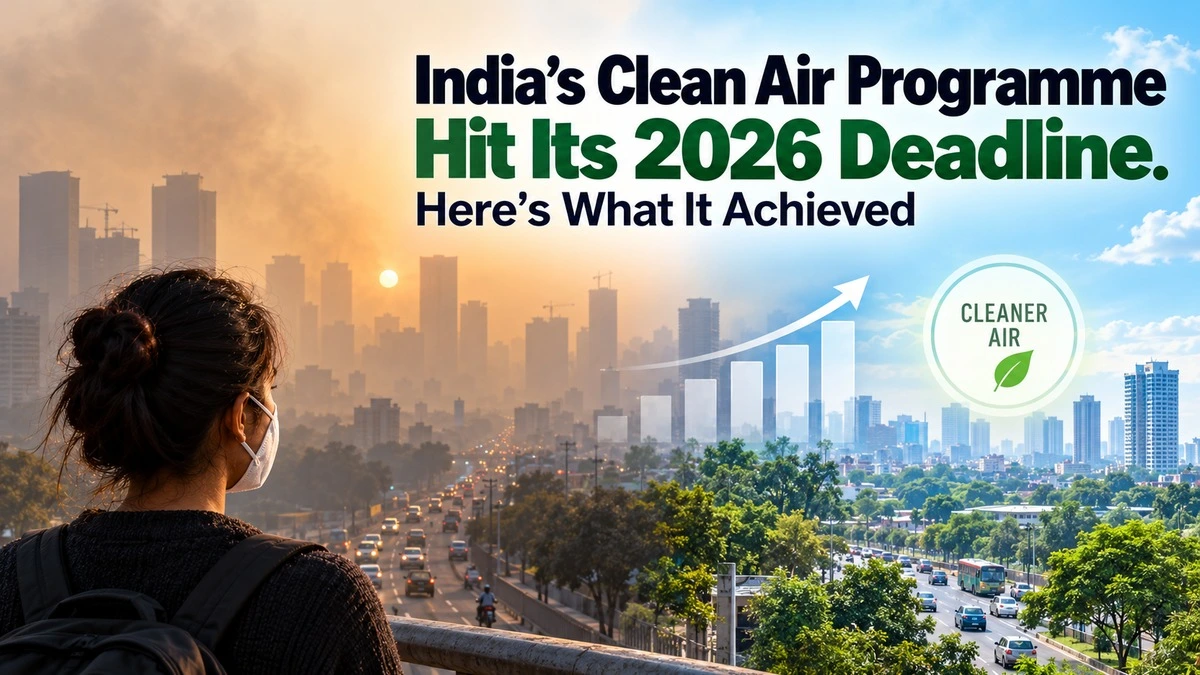
In 2019, India set itself a clear clean-air goal: cut particulate pollution in its most polluted cities sharply by 2025-26. That window has now closed. The numbers show real progress in a minority of cities, but the national programme has fallen well short of its target, and the reasons tell us a lot about what actually cleans a city’s air.
What NCAP promised
The National Clean Air Programme (NCAP) was launched by the Ministry of Environment, Forest and Climate Change in January 2019. It covers 130 cities across 24 states and union territories, most of them “non-attainment” cities that repeatedly failed national air quality standards.
The original goal was a 20-30% cut in particulate levels from 2017 levels by 2024. That was later revised to a tougher target: a 40% reduction in PM10 (coarser dust particles), or meeting the national PM10 standard, by 2025-26. Each city drew up its own action plan, and the Centre tied funding to measured improvement.
What the data shows
The independent research group Centre for Research on Energy and Clean Air (CREA) tracks NCAP each year. Its 2026 progress report, published in January, found:
MeasureResult
Cities that met the revised 40% PM10 cut23 of 130
Cities that met the original 20-30% cut51
Cities where PM10 went up23
NCAP cities still without a continuous monitoring station28
Funds allocated since launch₹13,415 crore
Funds actually used₹9,929 crore (74%)
Nationally, 190 of 229 cities with enough data still exceeded the PM10 standard in 2025. Delhi recorded the highest annual PM10 level, at 197 micrograms per cubic metre, more than three times the national limit of 60.
Why progress stalled
The money went mostly to dust

About 68% of NCAP spending went to road-dust control: water sprinklers, mechanical sweepers, paving and similar measures. Transport received 14%, waste and biomass burning 12%, and industry and household fuel less than 1% each.
From an engineering point of view, that split is the core problem. Dust control is visible and quick to buy, but it mostly targets PM10. The finer, more harmful PM2.5 comes largely from combustion: vehicle exhaust, industrial boilers, diesel generators, and wood or dung burned in homes. Sprinkling a road doesn’t touch a factory chimney or a kitchen stove.
You can’t fix what you don’t measure
Because funding is linked to measured improvement, weak monitoring undermines the whole system. With 28 NCAP cities lacking a continuous station, and only 90 of 130 having completed studies that identify where their pollution comes from, many cities are working without a reliable map of their own sources.
What this means for you
- Don’t read “progress” as “safe.” Even cities that hit the 40% target can remain well above national and WHO limits.
- Look at PM2.5, not just PM10. NCAP’s scorecard is built on PM10, but PM2.5 drives most of the health harm. Check both on your local CPCB station.
- Ask what your city is funding. Most city action plans are public. If yours is almost all sweepers and sprinklers, that’s worth raising with your municipal body.
The bottom line
NCAP gave India its first nationwide clean-air targets and a funding model tied to results, which matters. But seven years in, most cities haven’t reached the goal, and spending has leaned heavily toward dust while combustion sources went largely untouched. The next phase will only work if it follows the sources, not just the roads.
Related reading on our site: PM2.5 vs. PM10 explained, and why North India’s air gets so much worse every winter.
Sources
- CREA, Tracing the Hazy Air 2026: Progress Report on NCAP: energyandcleanair.org
- CPCB, PRANA portal for NCAP: prana.cpcb.gov.in
- CPCB, National Air Quality Index: airquality.cpcb.gov.in
- Ministry of Environment, Forest and Climate Change: moef.gov.in
About the author: Arjun Mehta, M.Tech. Environmental Engineering, works on air quality monitoring and emission control across Indian cities.
This article was researched and fact-checked against CREA’s 2026 NCAP progress report and official CPCB and MoEFCC sources and reviewed by our editorial team. Last updated: September 24, 2026.