


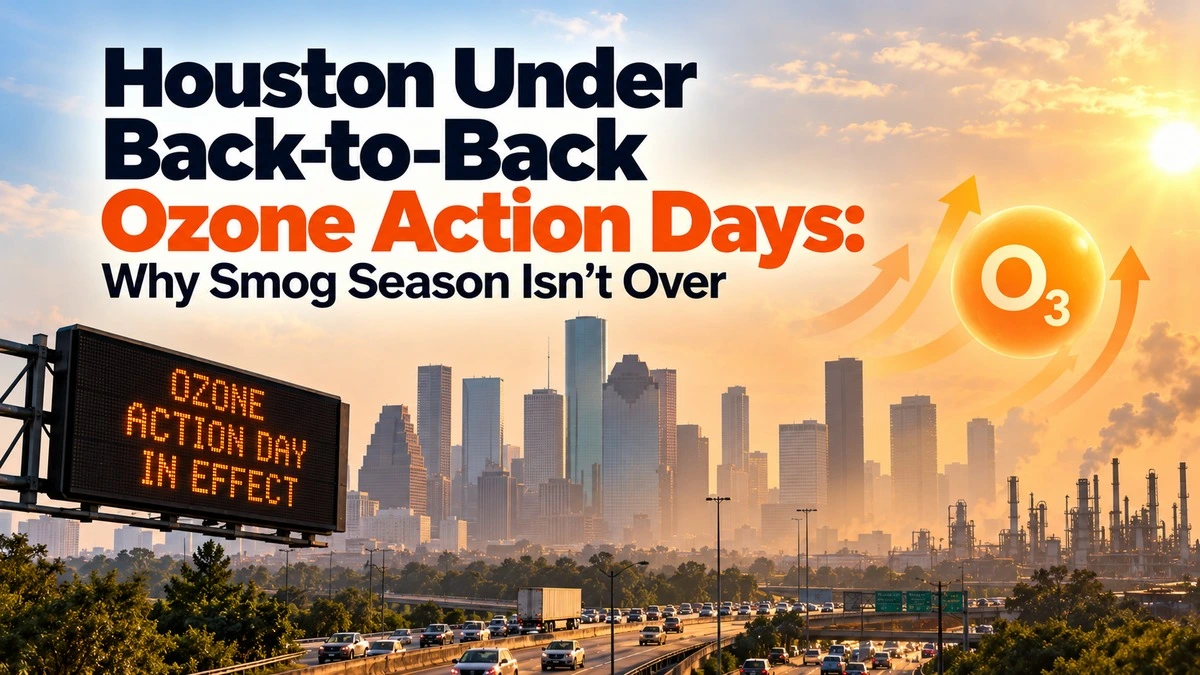
For the second day running, the Texas Commission on Environmental Quality (TCEQ) has declared an Ozone Action Day for the Houston, Galveston and Brazoria area. The first alert covered Wednesday, September 23, 2026; a follow-up issued that afternoon and relayed by the National Weather Service extended it to Thursday, September 24. Both carry the same warning: weather conditions are favourable for high levels of ozone pollution.
If you thought smog season ended with summer, Houston is a useful reminder that it doesn’t.
What an Ozone Action Day actually means
An Ozone Action Day is a forecast, not a measurement. TCEQ’s forecasters issue one when they expect ozone near the ground to climb to levels that are unhealthy for sensitive groups or worse. It’s a heads-up issued the day before, so people can plan around it.
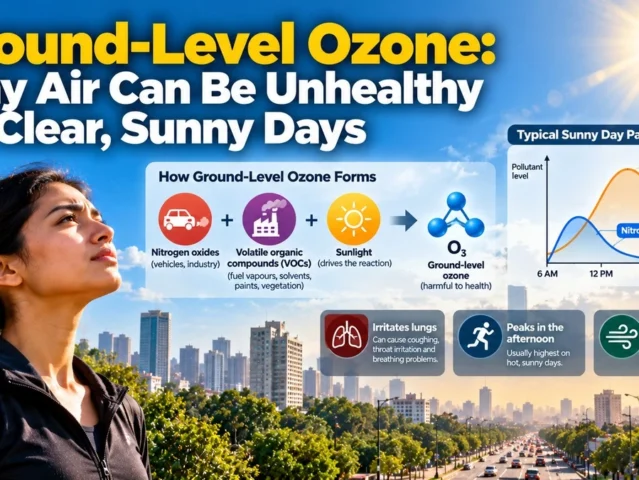
Ground-level ozone isn’t released from a tailpipe or smokestack. It forms in the air when two groups of pollutants, nitrogen oxides (mostly from vehicles and fuel burning) and volatile organic compounds (from fuels, solvents and industrial sites), react in sunlight. Think of it as a slow cook: the ingredients need strong sun, warmth and, crucially, still air to simmer together.
Why late September weather sets the stage
Houston’s ozone problem is as much about weather as emissions. On a breezy day, pollutants from the region’s traffic, port and petrochemical corridor get diluted and carried off. On a calm, sunny day, they linger over the same neighbourhoods for hours and keep reacting. Light winds that shift direction during the day can even push the same polluted air back over the city.
That’s why Houston’s ozone season doesn’t neatly end in August. Early autumn often brings exactly this pattern: plenty of sunshine, warm afternoons and weak winds between weather systems. The Houston-Galveston-Brazoria area has struggled for decades to meet federal ozone standards, and it remains on the EPA’s list of areas that don’t meet them.
The daily rhythm of ozone
Ozone follows the sun. Levels are usually lowest in the early morning, rise through late morning and peak in the afternoon and early evening before falling after dark. A useful way to picture this for readers would be a simple line chart of hourly ozone readings from a Houston monitor on an Action Day, with a gentle overnight trough and a sharp afternoon hump. Pair it with a second line for wind speed and you’d see the calm hours line up with the peak.
What this means for you
Ozone irritates the airways. It can cause coughing, a scratchy throat and chest tightness, and it can trigger asthma attacks. The people most at risk are children, older adults, anyone with asthma or other lung disease, and people who work or exercise hard outdoors.
- Move outdoor exercise to the morning. Because ozone peaks in the afternoon, an early run or practice session means far less exposure than a 4 p.m. one.
- Check the live number. Forecasts can miss in both directions. AirNow shows current readings for Houston by the hour.
- Keep reliever medication handy if you have asthma, and follow your action plan.
- Know what a mask can’t do. Ozone is a gas. Masks that filter particles, including N95s, don’t meaningfully block it.
Small steps that cut ozone
TCEQ asks residents to help on Action Days by sharing rides, walking or cycling, bringing lunch to work instead of driving out, skipping drive-through lanes, saving energy and keeping vehicles properly tuned. Refuelling in the evening rather than in the midday heat also means fewer fuel vapours escape while the sun is strongest. None of these steps fixes the problem alone, but ozone forms from millions of small emissions across a metro area, so collective habits matter on the worst days.
The bottom line
Two back-to-back Ozone Action Days in late September show that Houston’s air quality risk runs well past summer. The fix for most people is simple: shift strenuous outdoor activity to the morning, watch the hourly readings, and give sensitive family members extra care on the afternoons when the air is still and the sun is strong.
Related reading on our site: our explainer on ground-level ozone vs. PM2.5, and why AQI apps can show different numbers for the same spot.
Sources
- National Weather Service Houston/Galveston, Air Quality Alert relaying TCEQ Ozone Action Day for September 24, 2026: tgftp.nws.noaa.gov
- TCEQ, Today’s Texas Air Quality Forecast: tceq.texas.gov
- TCEQ, Ozone: The Facts: tceq.texas.gov
- US EPA, Ground-level Ozone Basics: epa.gov
- US EPA Green Book, nonattainment areas: epa.gov
- AirNow, Houston current air quality: airnow.gov
About the author: Dr. Lukas Müller, Ph.D. Atmospheric Sciences, specialises in atmospheric chemistry and how weather moves and transforms air pollution.
This article was researched and fact-checked against official TCEQ, National Weather Service and EPA sources and reviewed by our editorial team. Last updated: September 24, 2026.