




Winter is still weeks away, but this year’s pollution spike across the National Capital Region is behaving strangely. Delhi and Noida are sitting in the “Moderate” band, while satellite towns just a short drive away — Greater Noida, Gurugram, Manesar — have already slipped into “Poor” air. Residents used to Delhi topping every pollution chart are asking the obvious question: what changed?
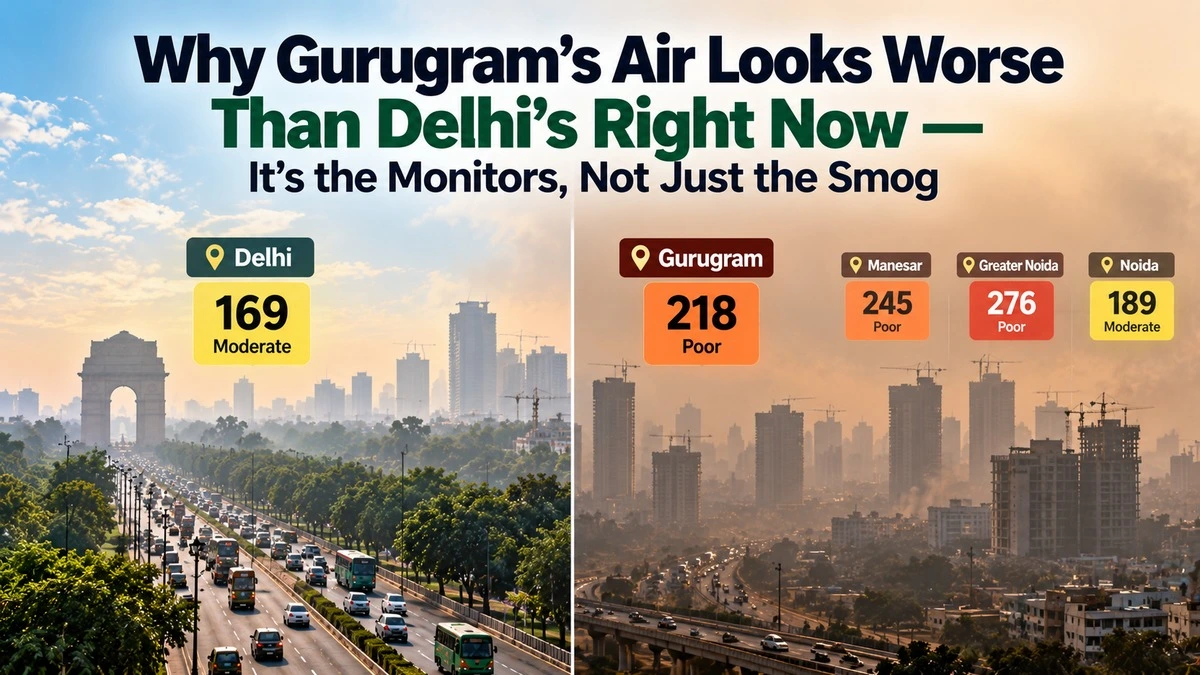
According to the Central Pollution Control Board’s daily AQI bulletin for September 21, 2026, Greater Noida recorded an AQI of 276, Baraut in Baghpat 286, Manesar 245, and Khora 254 — all “Poor.” Gurugram stood at 218, also “Poor.” Delhi, by contrast, read 169 and Noida 189, both “Moderate.”
It’s a Monitoring Gap, Not Just a Pollution Gap
Manoj Kumar, an analyst at the Centre for Research on Energy and Clean Air (CREA), told News18 that the difference comes down less to how much pollution each city actually has and more to how densely each city is measured. Delhi runs 46 air quality monitoring stations spread across the city. Gurugram has four. Noida has five or six.
That gap matters more than it sounds. Delhi’s citywide AQI is an average smoothed across dozens of sensors, including several in cleaner pockets of the city. A city with only four or five stations doesn’t get that averaging effect — if even one of those handful sits in a high-traffic corridor or an active construction zone, it can drag the entire city’s reported number into the “Poor” range, even if the rest of the city is breathing cleaner air.
Kumar’s advice for anyone trying to compare pollution across a city border, like Delhi-Gurugram or Delhi-Noida: don’t rely on the citywide average. Individual station-level data is publicly available on the government’s Sameer app, and it tells a more honest, local story than one blended number.
The Same Pattern Shows Up Elsewhere
This isn’t unique to the NCR. Mumbai’s Bandra-Kurla Complex station regularly reports among the city’s worst readings even though Mumbai’s overall average, drawn from roughly 30 stations, usually sits in the “Good” or “Satisfactory” range. In Chennai, the Thiruvanmiyur monitoring point typically reads “Satisfactory” while nearby industrial Gummidipundi has ranked among the most polluted locations in the country in recent months. A single citywide number can hide very different air on different streets — fewer, unevenly placed monitors means individual stations carry outsized weight in what gets reported.
Other Factors: Local Emissions and Missed Rain
Monitoring density explains part of the gap, but not all of it. Kumar pointed to two more factors: localized emission sources that vary sharply within a few kilometers, and uneven rainfall. Parts of Uttar Pradesh and Punjab saw rain in recent weeks, which helps settle particulate matter, but Gurugram largely missed those showers — one likely reason its pollutant levels have stayed higher than Delhi’s.
What Comes Next
Kumar cautioned against reading Delhi and Noida’s current “Moderate” numbers as a sign of genuinely clean air. The monsoon is doing quiet work here, washing pollutants out of the air before they can accumulate. Once the rainy season ends — typically by late September — and October begins, AQI levels across the entire region, Delhi included, are expected to climb as pollutants that rain currently disperses start building up again.
What This Means for You
- Gurugram, Greater Noida, or Manesar: don’t assume your area is automatically dirtier than Delhi — check your nearest individual station on the Sameer app rather than trusting a citywide comparison.
- Delhi or Noida: treat the current “Moderate” reading as temporary; expect it to worsen through October as the monsoon’s cleansing effect fades.
- Anywhere in NCR: free, public station-level data is a better guide for daily decisions like outdoor exercise timing than any single city average.
Written by Dmitri Volkov, B.Sc. Environmental Science, who works in environmental monitoring and air quality data interpretation. This article was researched and fact-checked against the cited sources below and reviewed by the AQI World editorial team.