


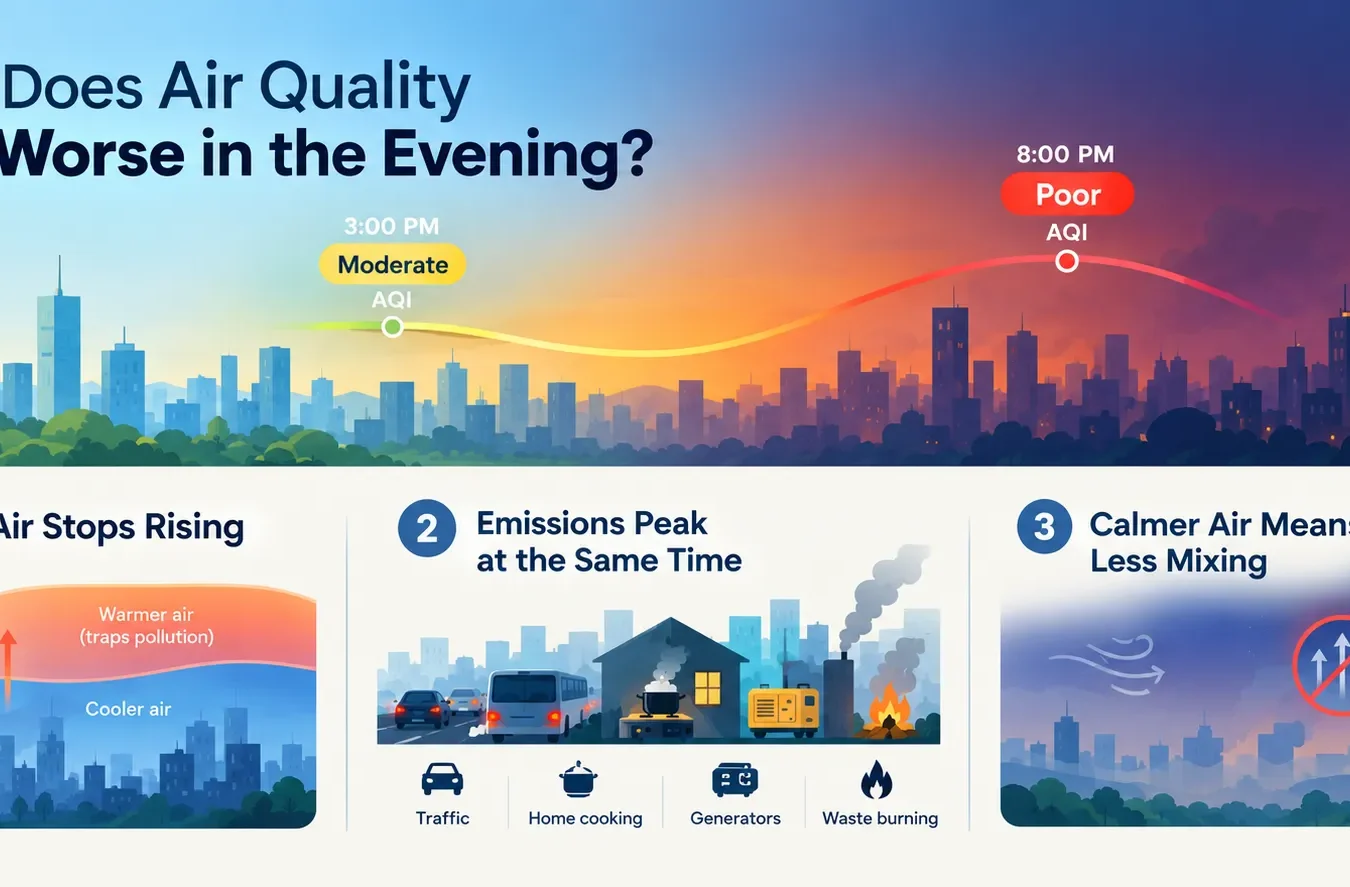
You check your AQI app at 3 p.m. and it says Moderate. By 8 p.m., the same neighbourhood reads Poor, and nothing obvious has changed. Your app isn’t glitching. The evening spike is one of the most common patterns in city air, and it comes from three things stacking up at once.
Cause 1: The Air Stops Rising
During the day, the sun heats the ground and warm air rises, carrying pollution up and away. After sunset the ground loses heat quickly, especially on clear nights. The air touching it turns cold while the air above stays warmer. This is called a temperature inversion. As the European Environment Agency puts it, the warmer air acts as a lid, trapping the colder air, and the pollution from sources like vehicles, close to the ground.
Picture a kitchen where someone shuts the ceiling vent just as the cooking starts. Same smoke, nowhere to go.
Cause 2: Emissions Peak at the Same Time
Evening is when several local sources overlap: rush-hour traffic, home cooking and, in some areas, diesel generators and small-scale waste burning. All of it lands in air that’s now moving less. Your neighbourhood isn’t suddenly dirtier. The same emissions are just being squeezed into a much thinner layer.
Cause 3: Calmer Air Means Less Mixing
Wind and daytime heating both stir the air and dilute pollution. At night both fade, so whatever is released near the ground stays near the ground until morning heating breaks the lid.
Why It Gets Worse in Winter
Early winter conditions produce stronger night-time inversions in North Indian cities such as Delhi, Kanpur and Patna, and smog can build quickly after sunset in that season. Cool, clear, still nights are exactly what a strong inversion needs.
Data visualization idea: Average one station’s hourly AQI over a week and plot it as a 24-hour line. Most urban stations show a dip in the afternoon and a rise after dusk, and the shape makes the pattern obvious at a glance.
What This Means for You
- Time outdoor exercise smartly: In winter, late morning to mid-afternoon is usually when the air has mixed the most.
- Protect your evenings: Close windows around dusk and run a purifier in the room where you spend the evening.
- Look at the trend: Don’t judge a day by one reading. Check the hourly trend on the CPCB station page before deciding.
- Don’t add to the load: Skip burning leaves or waste, avoid idling your engine, and use generators sparingly.
The evening spike is mostly physics plus routine: a lid on the air and everyone’s emissions arriving together. Once you know the pattern, you can plan around it.
Related reading: PM2.5 vs. PM10 explained, why North India’s air gets so much worse every winter, and whether air purifiers really work.
Sources
- European Environment Agency: Temperature inversion traps pollution at ground level
- AQI.in: Temperature inversion and air pollution
- arXiv: Investigation of the thermal structure in the atmospheric boundary layer during evening transition
- CPCB: Real-time National Air Quality Index
Last updated: September 19, 2026. Researched and fact-checked against primary sources and reviewed by our editorial team.