




By Arjun Mehta, M.Tech. Environmental Engineering | Air Quality Monitoring & Emission Control. Last updated: 23 September 2026.
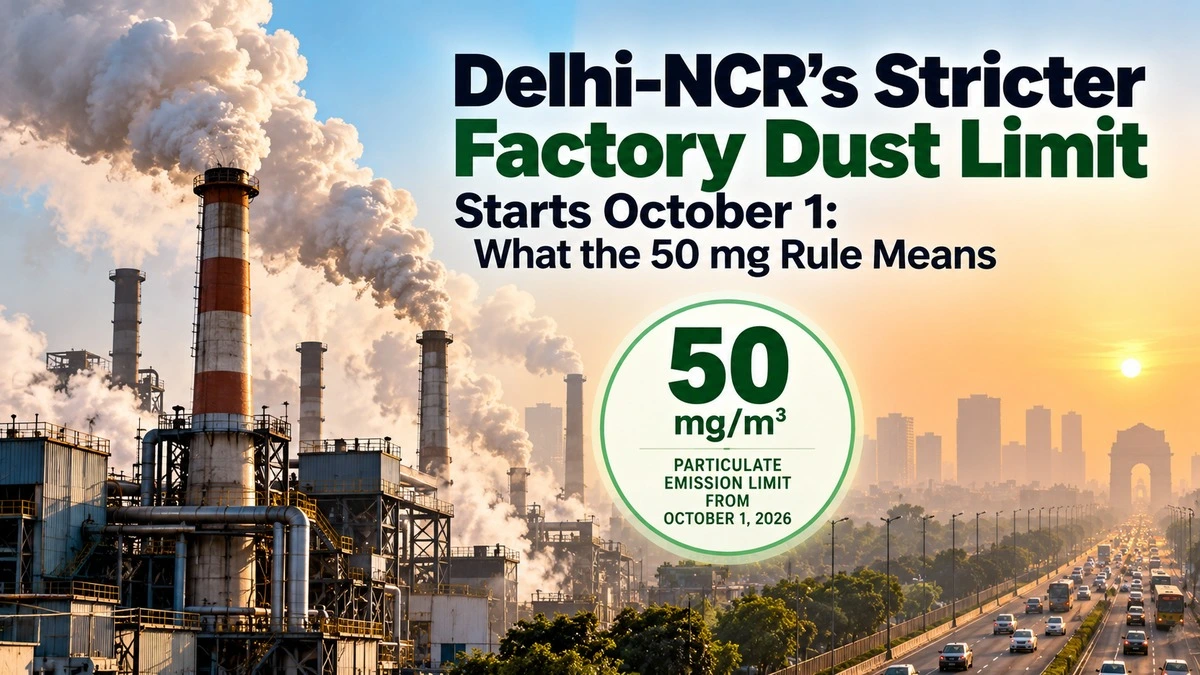
In eight days, factories across Delhi-NCR face a stricter cap on how much dust they can push out of their chimneys. From 1 October 2026, the Commission for Air Quality Management (CAQM) limits particulate emissions from a wide range of polluting industries to 50 mg per cubic metre of exhaust. The deadline lands just as the monsoon retreats and the region’s air begins its usual autumn slide.
What changes on October 1
CAQM first issued the rule in February 2026 as Direction No. 98 and later amended it. It covers:
- The 17 categories of highly polluting industries identified by the Central Pollution Control Board (CPCB)
- Red-category (medium and large) air-polluting industries
- Food and food-processing units
- Textile units running boilers or thermic fluid heaters
- Metal industries operating furnaces
The original direction set different deadlines by unit size. The amendment replaced them with one uniform date, 1 October 2026, for every covered unit. Units already bound by a tighter limit under their consent or other rules keep that tighter limit.
What “50 mg” means in practice
Think of it as a dust budget: each cubic metre of gas leaving a stack may carry about 50 milligrams of particles, roughly the weight of two or three grains of rice. Meeting that consistently usually takes working bag filters or electrostatic precipitators that are properly maintained and actually switched on.
Where enforcement stands
On 18 September, Union Environment Minister Bhupender Yadav and Uttar Pradesh Chief Minister Yogi Adityanath reviewed the air-pollution action plan for UP’s eight NCR districts, including Noida, Ghaziabad, Meerut, Hapur and Bulandshahr. According to the review, about 80% of industries there have installed air pollution control devices.
The meeting also pushed for:
- Faster installation of online continuous emission monitoring systems (OCEMS), which report stack emissions to regulators in real time
- Quicker rollout of electric buses and EV charging across NCR municipal corporations
- Number-plate recognition cameras at fuel stations to enforce “No PUCC, No Fuel”
That 80% figure cuts both ways. Most units are equipped, but roughly one in five isn’t, and “installed” doesn’t always mean “running.” A common gap in practice is a filter bypassed to save power or a torn filter bag left unreplaced. That’s exactly why real-time monitoring matters more than a one-time inspection.
Why the timing matters
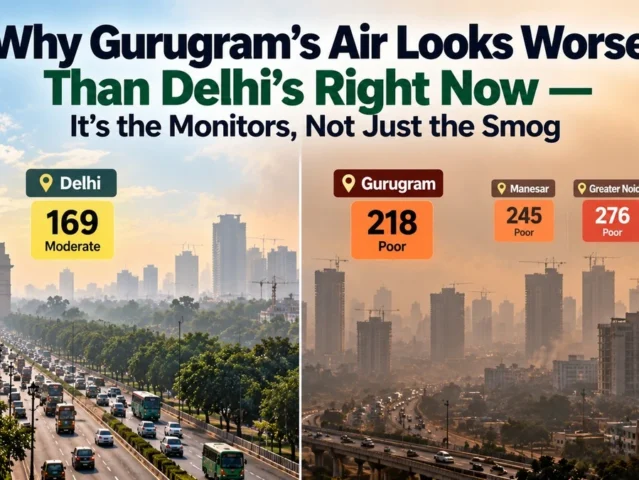
Delhi’s AQI has already climbed from 88 on 18 September to 169 on 21 September and 170 on 22 September, as dry weather and weak winds set in after the monsoon. PM2.5 and ozone have been the main pollutants. Industry is only one source alongside vehicles, road and construction dust, waste burning and, soon, crop-residue fires. Once winter inversions start trapping air near the ground, every source counts.
A simple bar chart of Delhi’s daily AQI from 18 to 22 September would show the jump clearly: from “satisfactory” to the top edge of “moderate” in four days. A second useful visual is a timeline marking 1 October (industrial dust limit) and 1 November (only BS-VI, CNG or electric buses allowed into Delhi).
What this means for you
- Live near an industrial cluster? Watch your nearest CPCB station rather than the city average. Industrial belts can run worse than the headline number.
- See heavy smoke from a stack? You can report it through CPCB’s Sameer app or your state pollution control board.
- Run a covered unit? Check the limit in your consent to operate, get a stack test done before 1 October, and make sure your pollution control equipment runs whenever the process does.
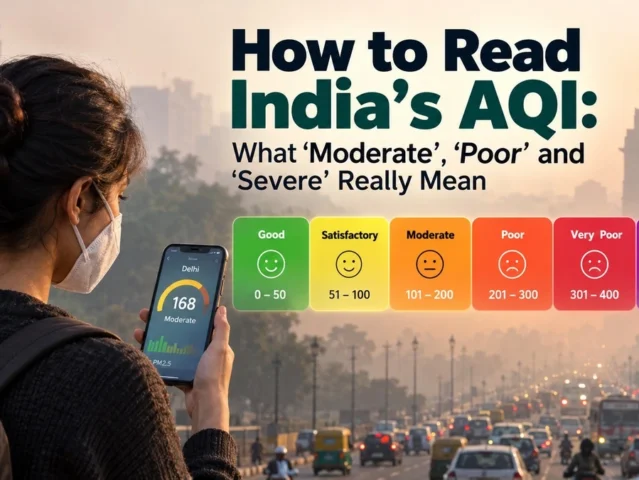
- Sensitive to pollution? On days the AQI crosses into “poor,” cut down hard outdoor exercise and consider a well-fitted N95 outdoors.
The October deadline won’t clean Delhi-NCR’s air by itself, but it removes one excuse just before the worst season begins. The real test is whether monitoring and enforcement keep the filters running through December.
Related reading: why North India’s air gets so much worse every winter, and what changes under Delhi’s 2026 winter pollution plan on 1 November.
Sources
- CAQM press release on Direction No. 98 (21 February 2026)
- SCC Online: CAQM revised PM emission standards for Delhi-NCR industries
- IANS via Social News XYZ: Bhupender Yadav, CM Yogi review UP’s air pollution action plan (18 September 2026)
- Dynamite News: Delhi AQI climbs to 169 as monsoon retreats
- CPCB daily AQI bulletin
This article was researched and fact-checked against official CAQM and CPCB releases and reviewed by our editorial team.