


By Dr. Ananya Sharma, Ph.D. Environmental Science | Air Pollution & Urban Air Quality. Last updated: 25 September 2026.
Open an air-quality app in Delhi this week and you’ll probably see a number between 100 and 200. Is that fine for a morning run, or should you stay indoors? India’s National Air Quality Index (AQI) is meant to answer that in one glance. But the category names don’t always mean what they sound like, and different apps can show different numbers for the same air. Here’s how to read the number calmly and correctly.
What the AQI actually is
The Central Pollution Control Board (CPCB) launched the National AQI in 2014. It takes readings for up to eight pollutants, including PM2.5, PM10, nitrogen dioxide, sulphur dioxide, carbon monoxide, ozone, ammonia and lead, and turns them into one number from 0 to 500. The final AQI is set by whichever pollutant is worst at that moment. It isn’t an average of all of them. In North India, that’s usually PM2.5 or PM10.
The six categories and what they mean
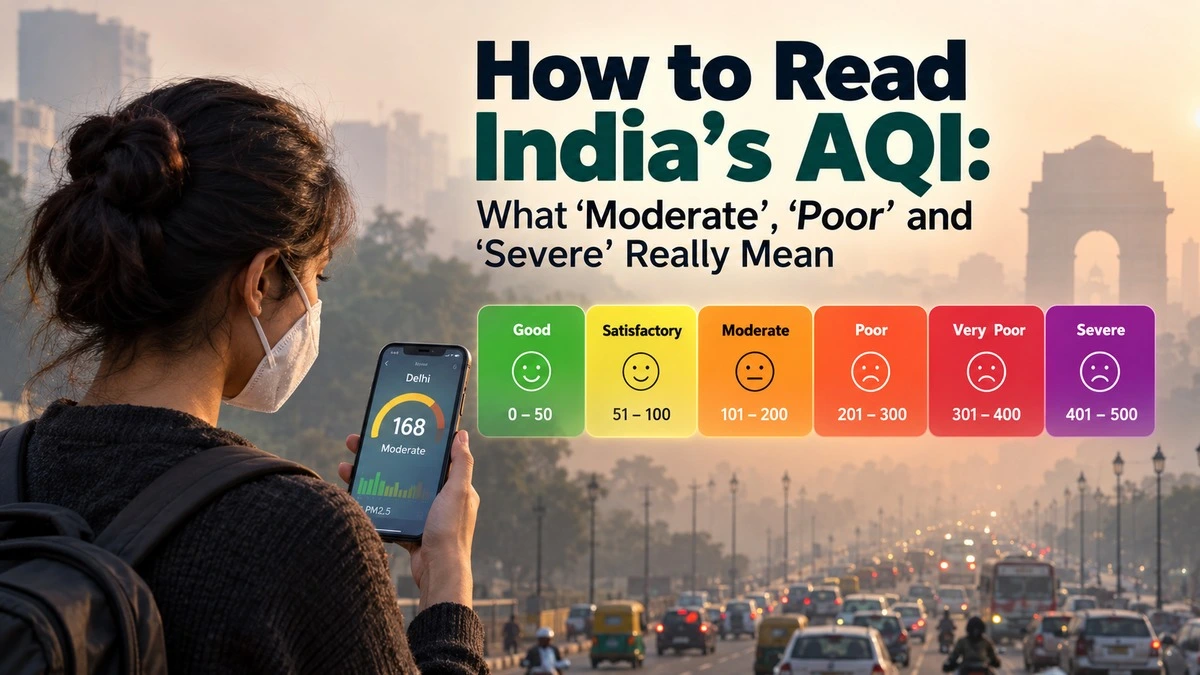
AQICategoryLikely health effect (CPCB guidance)
0–50GoodMinimal impact
51–100SatisfactoryMinor breathing discomfort for sensitive people
101–200ModerateBreathing discomfort for people with asthma or lung disease, and discomfort for people with heart disease, children and older adults
201–300PoorBreathing discomfort for most people on prolonged exposure
301–400Very PoorRespiratory illness on prolonged exposure
401–500SevereAffects healthy people and seriously affects those with existing disease
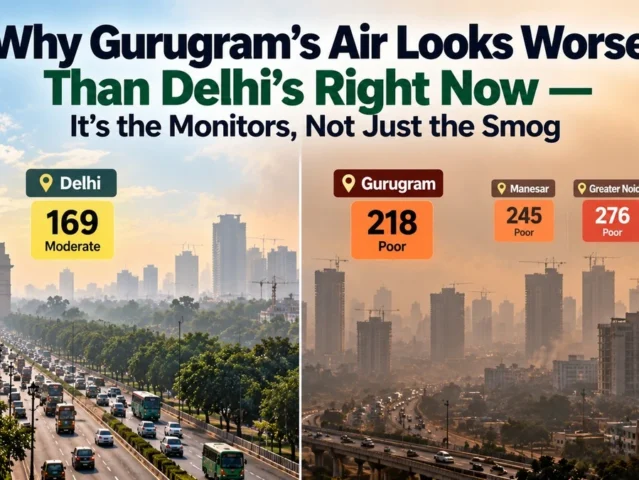
The word to watch is "Moderate." It sounds harmless, but on India’s scale it already means people with asthma, heart conditions, children and older adults may feel the effects. If you’re in one of those groups, a "Moderate" reading is when you start paying attention.
Why your apps disagree
Many popular apps use the US EPA scale rather than India’s. The two scales use different breakpoints and different labels. On the US scale, 101–150 is called "Unhealthy for Sensitive Groups," while on India’s scale the same number is simply "Moderate." A reading of 150 can sound mild on one app and worrying on another, even though the air is the same. Always check which scale an app uses before comparing numbers. For official decisions in India, the CPCB number is the one that counts.
Timing matters too. For particles, CPCB’s AQI uses 24-hour averages, so it moves slowly. A sensor showing live readings can jump sharply at 2 a.m. when traffic smoke gets trapped near the ground, then fall by noon.
Chart idea: a colour band showing India’s six categories next to the US scale, with the same numbers lined up, makes the label mismatch obvious at a glance.
The number also triggers action
In Delhi-NCR, the AQI sets off official measures under the Graded Response Action Plan (GRAP). Stage I starts when the AQI enters "Poor" (201–300), and stricter stages follow at "Very Poor" and "Severe." These can bring construction bans and vehicle restrictions. So as October approaches, the number on your screen tells you about more than your lungs. It can also hint at restrictions coming to your city.
What this means for you
- Know your group. If you’re sensitive, treat 101+ as your signal to cut down long, hard exercise outdoors.
- At 201+ (Poor), everyone should move workouts indoors or to cleaner hours and consider a well-fitting N95 outdoors.
- At 301+, keep windows closed during peak hours and run an air purifier if you have one.
- Check the source. Use the CPCB portal or SAFAR for official Indian readings, and treat other apps as a rough guide.
The bottom line
The AQI works well once you know its language. Remember three things: the worst pollutant sets the number, "Moderate" already matters for sensitive people, and a US-scale app won’t match CPCB. With those in mind, you won’t panic over the number or ignore it.
Related reading: PM2.5 vs PM10 and why the smaller particle is more dangerous, and how stubble burning affects winter air in North India.
Sources
- CPCB National Air Quality Index portal
- Central Pollution Control Board
- SAFAR (IITM Pune) air quality forecasts
- Commission for Air Quality Management (GRAP)
- AirNow.gov: AQI basics (US EPA scale)
This article was researched and fact-checked against CPCB, CAQM and US EPA sources and reviewed by our editorial team.