





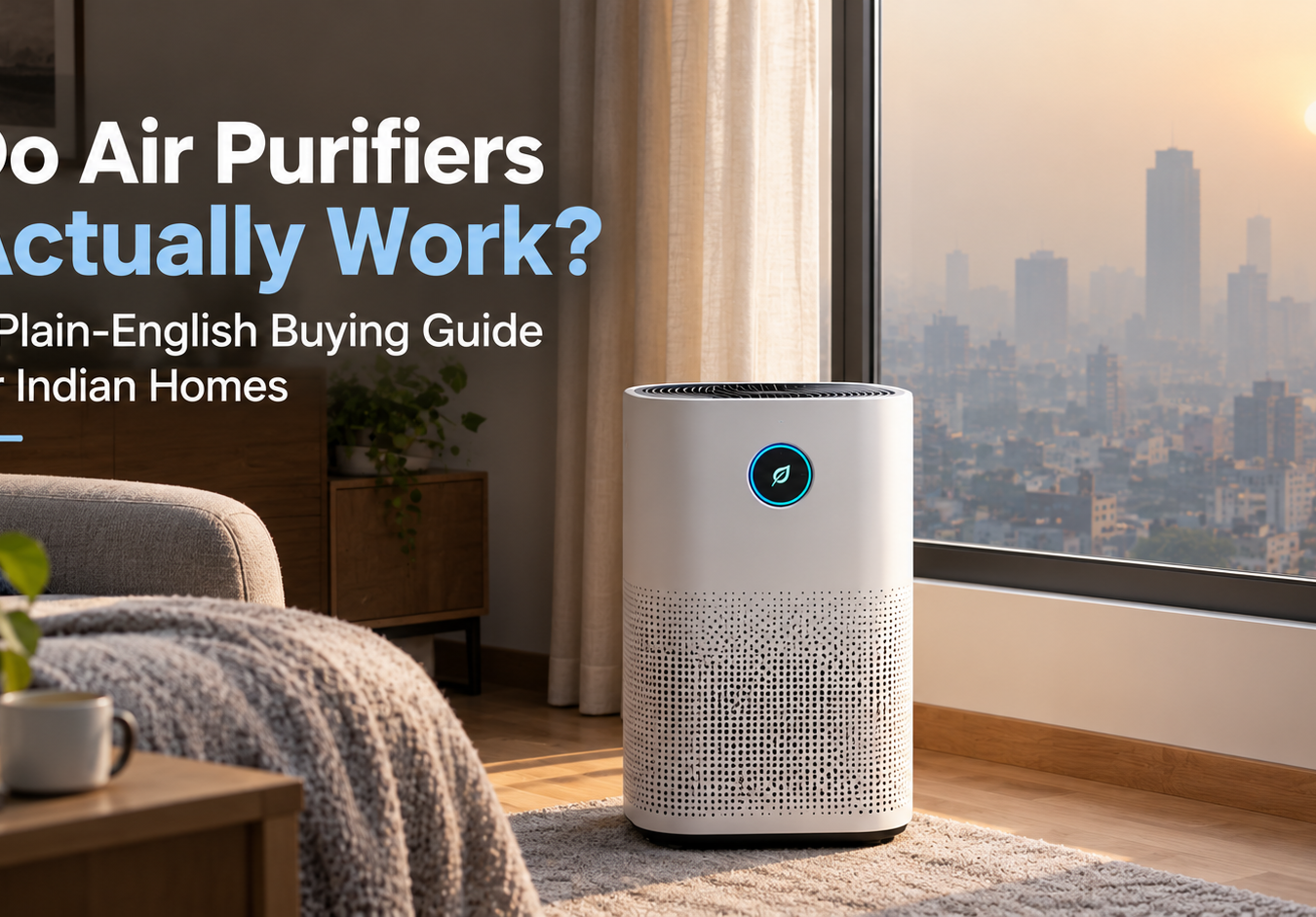
As India heads into its smoggy season, air purifiers fly off the shelves. Some genuinely help. Others are expensive fans with a good logo. Here’s how to tell the difference without reading a single spec sheet twice.
By Arjun Mehta, M.Tech. Environmental Engineering (Air Quality Monitoring & Emission Control). Researched and fact-checked against the primary sources listed below and reviewed by our editorial team. Last updated: October 6, 2026.
How a purifier actually works
A purifier pulls room air through a filter and pushes cleaner air back out. It can’t remove the pollution outside, and it can’t clean air it never pulls in. So what matters is how good the filter is and how much air the machine moves.
The three things to check
1. A true HEPA filter
A true HEPA filter is built to trap at least 99.97% of the tiniest, hardest-to-catch particles in lab testing. That includes the PM2.5 that drives most of the health worry during Indian winters. Be wary of labels like “HEPA-type” or “HEPA-like.” They aren’t the same standard.
2. The clean-air delivery rate (CADR)
CADR tells you how much clean air the machine delivers per hour. The U.S. EPA’s consumer guide suggests a simple rule of thumb: choose a unit whose smoke-rated CADR is about two-thirds of your room’s floor area. A bigger room with a small machine means the air is barely cleaned before it gets dirty again.
3. Running costs
Filters wear out. Ask the price and the replacement interval before you buy, because a cheap machine with expensive filters costs more over two years than a pricier one.
What purifiers can’t do
- They don’t help much if doors and windows stay open to polluted air.
- They won’t remove gases like cooking fumes or ozone unless they carry a proper activated-carbon layer.
- They aren’t a substitute for fixing the source. Dust from construction, diesel generator exhaust and vehicle smoke are cheaper to stop than to filter.
Avoid any device that advertises ozone or “ionisation” as its main trick. The EPA notes ozone is itself a lung irritant.
Where to place it
Put it in the room where you spend the most time, usually the bedroom. Keep it a little away from walls so air can flow in, close the windows and run it on a steady setting overnight. Check your outdoor AQI reading first: if outside air is moderate, you can open windows briefly to ventilate.
What this means for you
If your area regularly sees “Poor” or worse readings under the national AQI, a right-sized HEPA purifier in the bedroom is a sensible investment, especially with children, older adults or anyone with asthma at home. If your AQI is mostly moderate, better habits (wet mopping, no burning waste, closing windows during evening spikes) go a long way.
Charts that would help
A simple bar chart comparing five-year costs (machine plus filters) of two sample models would show why running costs matter. A line chart of indoor versus outdoor PM2.5 across a night with the purifier on would show the real-world effect.
Bottom line
Buy a true HEPA unit sized for your room, plan for filter costs, and keep the windows shut when the air outside is bad. A purifier is a tool, not magic.
Related reading
- How to read India’s AQI: what “Moderate”, “Poor” and “Severe” really mean
- PM2.5 vs PM10: what’s the difference?