

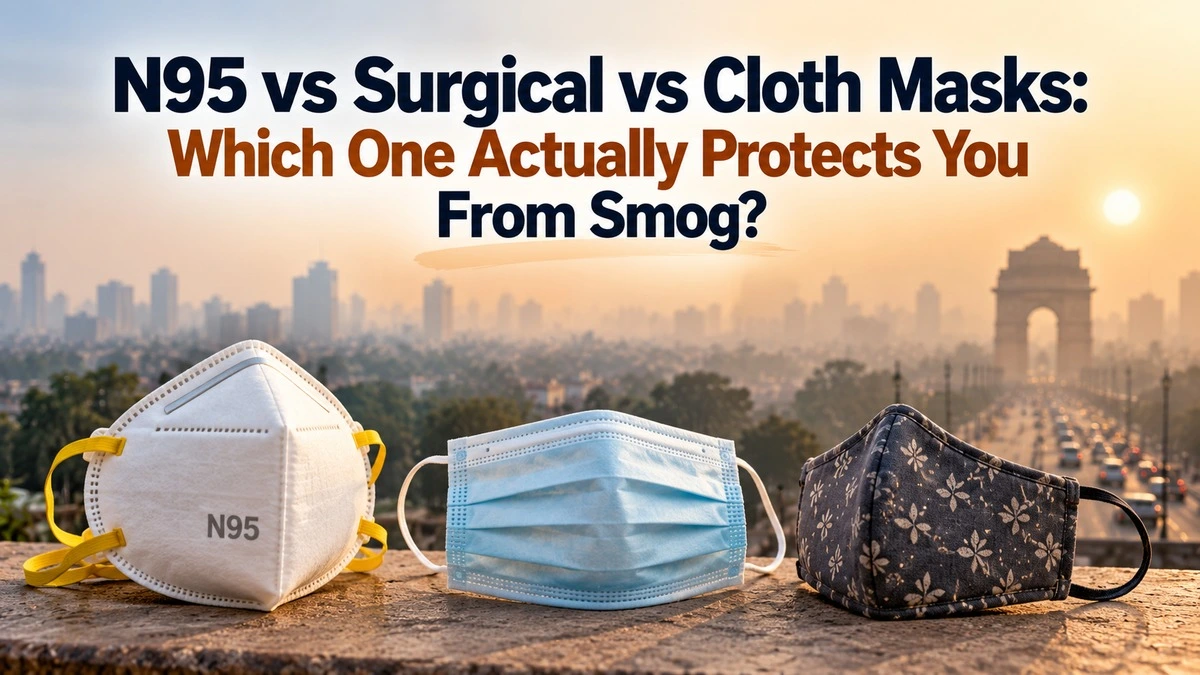
Smog season is near, and so is the mask question. Do those thin blue surgical masks help? Is an N95 worth the money? The short answer: the type of mask matters far less than whether it seals to your face.
What a mask can and can’t do
Smog is mostly tiny particles, like PM2.5, that are about 30 times thinner than a human hair. A mask that stops them has to work like a very fine net, and it has to leave no gaps around the edges. Masks stop particles. They don’t stop gases such as ozone or carbon monoxide.
The mask types, compared
MaskProtection against fine particlesVerdict for smog
Cloth mask or scarfPoor. Loose weave, gaps at the sides.Not recommended
Surgical (blue) maskLimited. Designed to catch droplets, and it fits loosely.Not recommended for smog
N95, KN95, KF94, FFP2Good when sealed. Built to filter fine particles.Recommended
N99, FFP3, P100Higher filtering, but harder to breathe through.Useful if you have the right fit
An “N95” label means the filter is certified to catch at least 95% of very small test particles. That figure applies only to the filter itself. If air leaks around your nose or cheeks, the real protection drops, sometimes by a lot.
Fit is the whole game
Health guidance on smoke respirators repeats the same point: pick a certified respirator with two straps that go around your head, and make sure it seals. Ear-loop masks are easier to wear but often leak.
- Pinch the metal strip firmly over your nose bridge.
- Breathe in sharply. The mask should pull slightly toward your face. If air whooshes in at the edges, adjust it.
- Beards and stubble break the seal. A clean-shaven edge makes a real difference.
- Avoid valves if you’re worried about spreading germs. The valve helps you breathe out, but it doesn’t make the mask filter better.
What Indian health advisories say
AIIMS New Delhi’s public advisory for the pollution season recommends N95 masks outdoors and suggests using the SAMEER app, from the environment ministry, to decide whether it’s safe to go out. Guidance from US health groups adds that staying indoors with cleaner air is usually the most effective step. Masks are for the times you can’t avoid being outside.
What this means for you
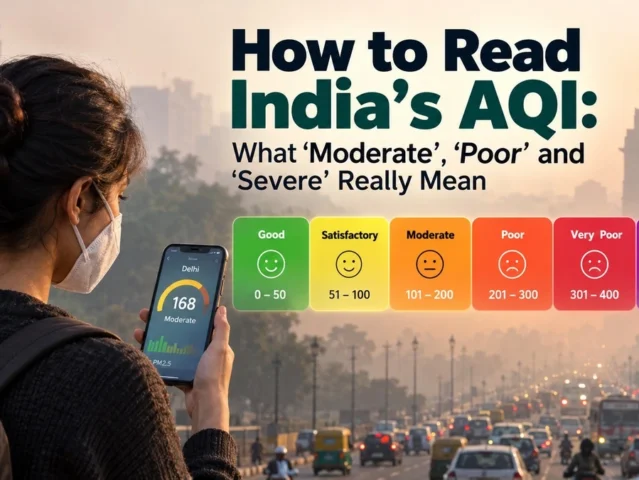
- Moderate (101–200): Most healthy adults don’t need a mask. People with asthma or heart conditions may want one for long outdoor time.
- Poor (201–300) and worse: Wear a well-fitted N95-type mask on commutes or when outside for a while, and consider skipping outdoor workouts.
- Children: Fit is the issue. Guidance for families says masks should only be used for children over age 2 who can tell you if they’re uncomfortable, and many adult masks won’t fit small faces.
- Heart, lung or breathing conditions: Talk with your doctor first. A respirator makes breathing harder, which can be a problem for some people.
- When to replace: If it’s damp, dirty, bent out of shape, or breathing gets harder, swap it for a new one.
Data-viz idea
A simple diagram of a mask seen from the side, with arrows showing air going through the filter and air leaking at the edges, would show why a snug fit beats a high rating. A second chart could place the mask types on a scale from “loose fit” to “sealed fit”.
The bottom line
A well-fitted N95-type mask is a sensible tool on bad air days, but it isn’t a cure. Pair it with checking live AQI, limiting time outdoors and keeping indoor air clean. A cheap mask that fits beats an expensive one that doesn’t.
Related reading: do air purifiers actually work, how to read India’s AQI categories, and PM2.5 versus PM10.
Sources
- Pediatric Environmental Health Specialty Unit: Wildfires and Mask Use for Families
- Business Standard: AIIMS issues health advisory on Delhi air pollution
- UC Santa Barbara EHS: Recommended N95 Respirators for Wildfire Smoke
- CPCB National Air Quality Index portal
By Arjun Mehta, M.Tech. Environmental Engineering | Air Quality Monitoring & Emission Control. This article was researched and fact-checked against the cited sources and reviewed by our editorial team. Last updated: October 9, 2026. This is general information, not medical advice.