


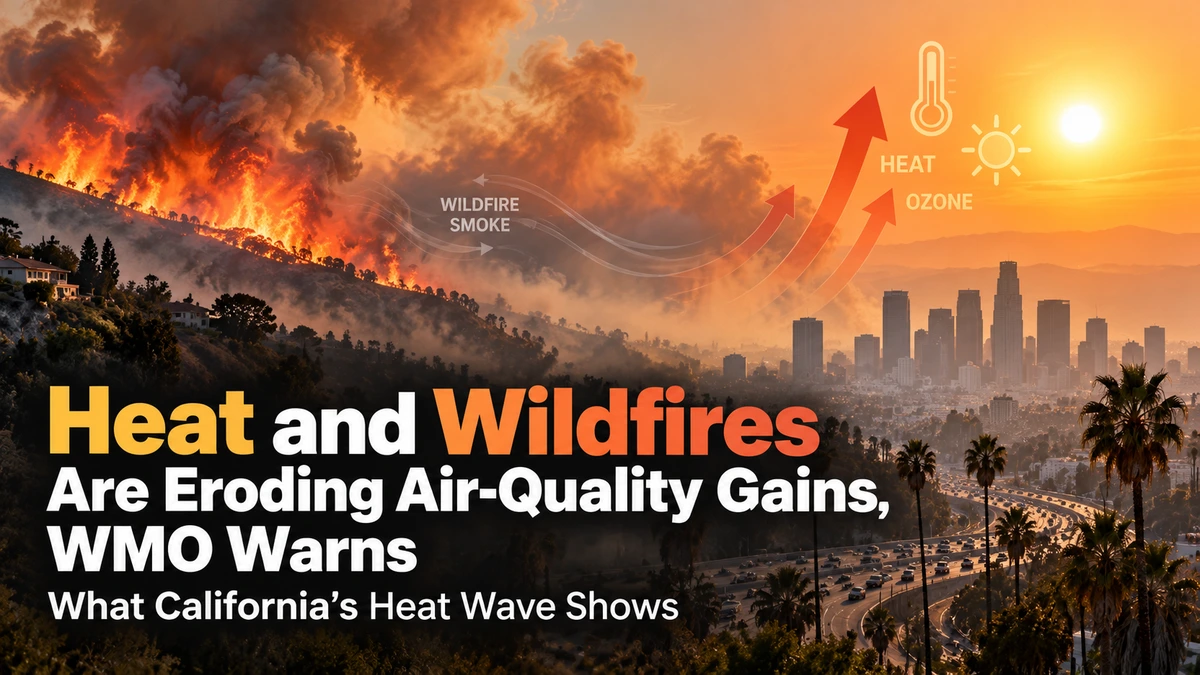
Cleaner factories and cars haven’t been enough to keep the air clean. That’s the central message of the World Meteorological Organization’s sixth Air Quality and Climate Bulletin, released on 7 September 2026. Heat and wildfires are now undoing some of the gains, and a heat wave baking California this month shows how it plays out in real time.
By Dr. Lukas Müller, Ph.D. Atmospheric Sciences (Atmospheric Chemistry & Air Pollution), Zurich. Researched and fact-checked against primary sources and reviewed by our editorial team. Last updated: 11 October 2026.
What the WMO found
The bulletin looks back at 2025. Its headline finding: emissions from industry and transport fell in Europe and North America, but people’s exposure to wildfire smoke went up. Fine particle levels (PM2.5) ran above the long-term average in northern Canada, parts of Russia and western-central Africa because of fires. Northwestern Spain became a hotspot after exceptional late-summer blazes. China came in below average. India stayed above average, which the WMO links to biomass burning and other sources.
The WMO’s Lorenzo Labrador made a point worth remembering: a city with generally clean air can still be hit by harmful smoke that travelled a long way.
Why heat makes the air worse, too
Heat doesn’t just feel bad. On hot, sunny, still days, gases from vehicles and industry react with sunlight and form ground-level ozone, the main ingredient of smog. This is a different thing from the protective ozone layer high above us. The bulletin cites studies of heat waves in Europe, China and the southeastern United States suggesting tens of thousands of extra early deaths from added ozone exposure, and it expects the risk to grow as heat waves become more frequent.
California: a live example
In early October, a long heat wave broke daily records across Southern California. The National Weather Service said Santa Ana reached 41.7°C, about 2.8°C above its old record for the date, and San Diego airport hit 40.6°C. More than 34 million Californians were under heat warnings or advisories. CAL FIRE reported 5,701 wildfires and about 328,950 acres burned so far this year (preliminary figures), and AirNow forecasts showed unhealthy air for sensitive groups, with ozone the main pollutant in several areas. South Coast AQMD also issued a smoke alert for parts of the Los Angeles area on 3 October.
A warning about smoke toxicity
The WMO also cites a study suggesting that standard models, which only count the total weight of particles, could underestimate wildfire-smoke deaths by as much as 93%. The reason: smoke particles may be more harmful than the same weight of ordinary city dust. Another cited study found extreme smoke events have tripled worldwide since the 1990s, with nearly 100,000 extra deaths a year between 2010 and 2018. The WMO says that may be an underestimate.
What this means for you
- Check the air on hot days, not just smoky ones. Ozone peaks in the afternoon; do hard exercise in the morning when you can.
- Clean-air cities aren’t safe from smoke. Keep a good mask (N95 or equivalent) and a way to check live air quality.
- Close windows during smoke. Use recirculate mode on air conditioning and move to a cooler, cleaner room if needed.
- In India, remember that the stubble-burning season is under way; farm-fire smoke is part of why the country sits above the global average.
Data-viz ideas
A world map shading each region by whether its 2025 PM2.5 was above or below its long-term average would show at a glance where fires pushed levels up. A simple two-line chart, with heat on one line and ground-level ozone on the other, would show the two rising together on hot days.
The bottom line
Cutting tailpipe and chimney emissions still works, but a hotter, drier world is adding a new source of pollution that borders don’t stop. Climate and air-quality policy need to be planned together, as the WMO recommends.
Related reading
- Ground-level ozone explained: why sunny days can be unhealthy
- How Indonesian peat-fire haze travels across borders
- N95 vs surgical vs cloth masks for smoke