


Last updated September 13, 2026.
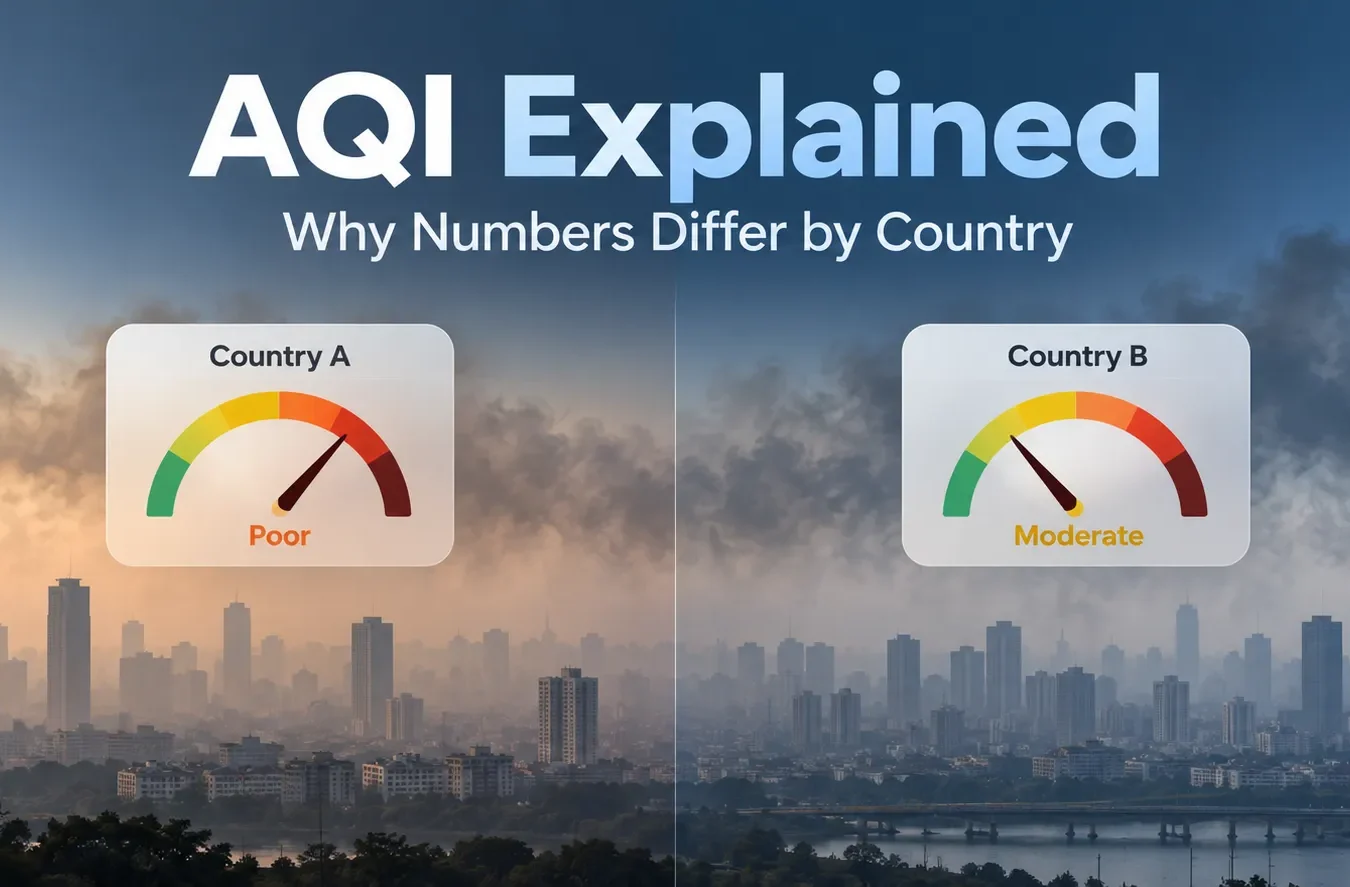
During this month’s Southeast Asia haze crisis, Kuching, Malaysia reported an AQI of 399 while Pontianak, Indonesia reportedly hit 900+ in the same event. The natural read is that Pontianak’s air was more than twice as dangerous. That’s not a safe conclusion — the two countries don’t grade air quality on the same scale, and one of them isn’t even supposed to go past 500.
If you’ve ever wondered why one app says “moderate” and another says “unhealthy” for what feels like the same smoggy sky, this is why. Here’s what AQI actually is, in plain terms, and how to read it without getting tripped up by the number.
AQI isn’t a direct measurement — it’s a translation
Monitoring stations measure the actual amount of pollution in the air — how many micrograms of soot (PM2.5) are packed into a cubic meter, for instance. That raw number isn’t very meaningful to most people, so agencies translate it into a simple 0–500 score using a lookup scale set by their own government. Higher concentration in, higher score out — but where exactly each score cutoff falls is a policy choice, not a law of physics.
That’s the part that trips people up: the concentration of pollution is real and physical; the “AQI number” is a label a country puts on it. Different countries use different labels for the same physical air, the same way two rulers marked in different units can measure the same table and show different numbers.
Where countries actually disagree
- United States (updated in 2024): tightened its “Good” cutoff after research linked harm to lower pollution levels than previously thought — air that used to count as “Good” can now register as “Moderate.”
- India: uses a noticeably looser cutoff for what counts as safe PM2.5 pollution than the current US standard.
- Malaysia: uses a scale close to — and in places stricter than — the US one, which is part of why Kuching’s 399 already counted as “hazardous.”
So the same smoky air could register as “Moderate” in one country’s app and “Unhealthy” in another’s, purely because of where each government drew its lines. And a reading like Indonesia’s reported 900+ almost certainly comes from a scale that keeps counting past the point where the standard US-style scale stops — that scale is capped at 500 by design. A very high number on any scale means the same practical thing (the air is dangerous), but numbers from different countries shouldn’t be compared like-for-like.
The six categories worth knowing
AQICategoryWhat to do
0–50GoodEnjoy the outdoors
51–100ModerateFine for most people
101–150Unhealthy for Sensitive GroupsKids, older adults, pregnant people, and anyone with asthma or heart/lung disease should ease off outdoor exertion
151–200UnhealthyEveryone may start to feel it
201–300Very UnhealthyHealth alert for the whole population
301–500HazardousEmergency-level air — stay inside
The label matters more than the exact number. Whether a reading says 137 or 151 shouldn’t change your plans much; whether it says “Unhealthy for Sensitive Groups” versus “Unhealthy” should.
The one number every country agrees is the real target
The World Health Organization publishes health-based pollution guidelines in plain concentration terms, not a country-specific score. Its 2021 guidance recommends fine-particle pollution stay under roughly a fifth of what the older 2005 guidance allowed, reflecting stronger evidence that harm starts at lower levels than once believed. Worth knowing: every country’s own “Good” or “safe” band — including the US’s newly tightened one — still permits several times more pollution than WHO recommends. No government’s legal “safe” line currently matches what the health research actually supports.
What this means for you
- Don’t compare AQI numbers between countries at face value — a “199” in one place and a “199” in another aren’t guaranteed to mean the same air.
- Go by the plain-language category (Good, Moderate, Unhealthy, etc.), not the exact digit.
- If you’re pregnant, older, very young, or have asthma or heart/lung disease, treat “Unhealthy for Sensitive Groups” as your own personal cutoff to cut back on outdoor time — don’t wait for “Unhealthy.”
- Check which country’s scale your weather app is using before comparing a reading here to one you saw somewhere else.
The number in your weather app is a translation, not a raw fact. Before comparing two cities’ air quality, make sure they’re speaking the same language.
Data to watch
A simple side-by-side bar chart showing how the same smoggy air (one hypothetical pollution level) would score under the US, Indian, and Malaysian scales would illustrate the same air producing three different numbers.
Related reading
- Southeast Asia’s 2026 haze crisis, city by city
- What is PM2.5, and why it matters most
Sources
- IQAir. (2026, September 1). Transboundary Air Quality Alert: Southeast Asia.
- Handley, Erin. (2026, September 7). Indonesian wildfires spurred by super El Niño choke South-East Asia. ABC News.
- World Health Organization, via IQAir. (2021). New WHO air quality guidelines will save lives.
- U.S. EPA, via Federal Register. (2024, March 6). Reconsideration of the National Ambient Air Quality Standards for Particulate Matter.
- aqicn.org. South Asian Air Quality Scales: Malaysia and Thailand.
This post was researched and fact-checked against the official sources listed above, using current air-quality standards and reporting. It’s reviewed by our editorial team before publishing, and we’ll update it if any of these standards change.


