



Last updated September 13, 2026. Conditions are changing daily; figures reflect reporting as of this date.
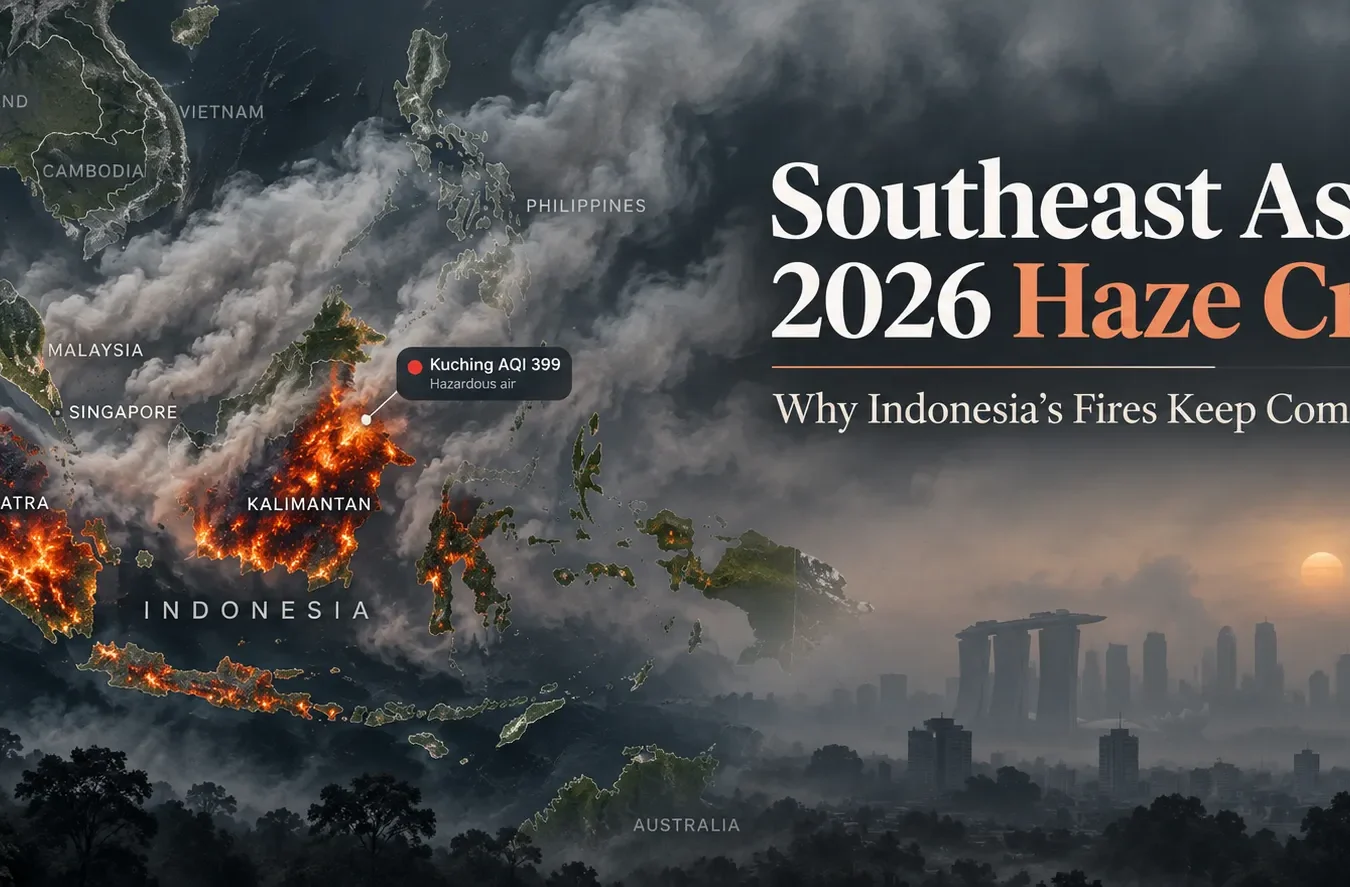
On September 5, Malaysia’s king approved a state of emergency for Sarawak’s Serian Division, closing 647 schools and shutting offices, plantations, and quarries because the air had turned hazardous. Days earlier, Kuching’s AQI hit 399 — briefly the worst reading of any city on Earth — and satellite data had logged over 444,200 fire hotspots across Indonesia this year, 4.5 times the count from late July. Multiple assessments now describe conditions as worse than 2015, the region’s previous benchmark bad year.
What’s burning, and why now
The fires are concentrated in Indonesia’s Kalimantan and Sumatra peatlands, and they’re overwhelmingly human-set — land-clearing ahead of planting season, with roughly half occurring inside oil palm concessions. Indonesia has arrested 72 people on arson suspicion and is investigating four companies. What’s turned an annual problem into a crisis is a “super” El Niño: some areas have gone 60+ days without rain, and dried peat can smolder for weeks, resisting water-bombing. Below-normal rainfall is forecast through October, so this isn’t close to over.
How far it’s spread
IQAir’s regional alert placed six Southeast Asian cities among the world’s 20 most polluted in early September: Kuching (1st), Kuala Lumpur (4th), Medan (10th), Singapore (17th), Jakarta (20th), and Manila (29th) — Manila sits over 1,000 km from the nearest fires. Some Indonesian monitors, including in Pontianak, reportedly read above 900 — but that number comes from a different country’s scale than Malaysia’s 399, so the two aren’t directly comparable. Both describe dangerous air; neither is “twice as bad” as the other just because the number is bigger. Singapore recorded its first unhealthy air since 2023.
The health toll is already substantial: 50,891 acute respiratory infection cases regionally in July–August, and Malaysia saw asthma cases jump 259% in a single week.
What this means for you
- In an affected city? Check a real-time monitor before heading out — Malaysian officials have urged minimizing outdoor and strenuous activity.
- Sensitive groups (asthma, COPD, heart disease, pregnancy, young children): mask up (well-fitted N95) and run an indoor purifier at moderate readings, not just hazardous ones.
- Traveling to the region soon? Don’t assume it’s cleared — recheck close to your travel date.
What to watch next
Whether October’s rains arrive on schedule, whether Indonesia’s arrests deter new ignitions, and whether Malaysia’s cross-border cloud-seeding meaningfully cuts the peat-fire load. Peatland fires typically persist until sustained rain — not a single good week — douses them.
Southeast Asia’s haze seasons are a preventable problem colliding with an unpreventable one. If you’re in the affected zone, check your local monitor before the skyline.
Data to watch
A ranked bar chart of the six cities’ AQI readings (Sept 1–3), color-coded by health category, would show severity fading — but staying unhealthy — over 1,000+ km of distance from the source.
Related reading
- How AQI is calculated, and why national scales don’t match
- Protecting sensitive groups during a smoke event
Sources
- Handley, Erin. (2026, September 7). Indonesian wildfires spurred by super El Niño choke South-East Asia. ABC News.
- Al Jazeera. (2026, September 5). Malaysia declares emergency in Sarawak as haze from Indonesia worsens.
- Mongabay. (2026, September). As Indonesia’s wildfires rage, haze spreads farther across Southeast Asia.
- IQAir. (2026, September 1). Transboundary Air Quality Alert: Southeast Asia.
This post was researched and fact-checked against the official sources listed above, using current air-quality and weather reporting. It’s reviewed by our editorial team before publishing, and we’ll update it as conditions change.


