


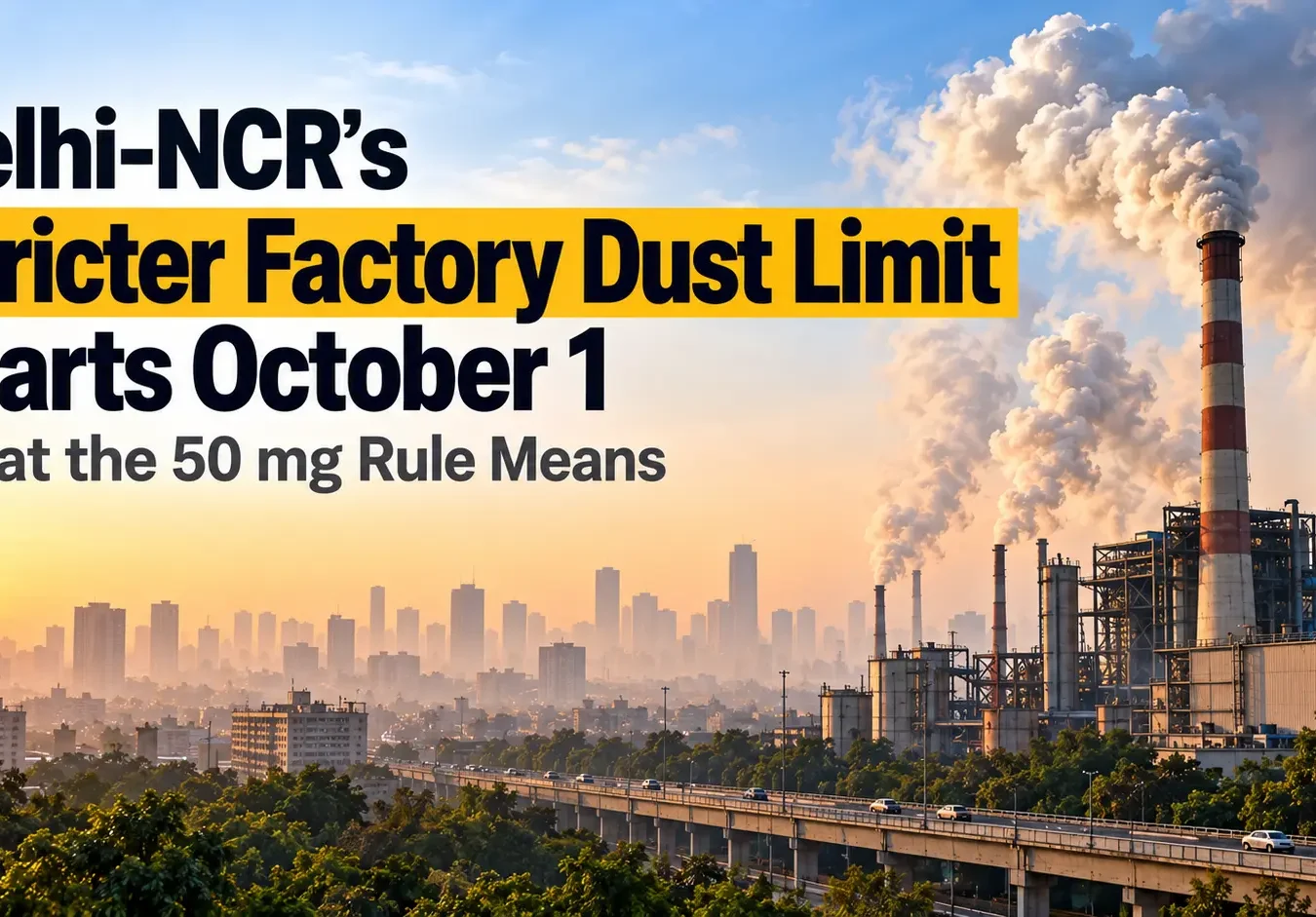
Starting October 1, 2026, hundreds of factories and industrial units across Delhi-NCR have to hit a stricter smokestack limit: 50 milligrams of particulate matter per normal cubic metre of exhaust (50 mg/Nm³). The deadline comes from a directive the Commission for Air Quality Management in NCR (CAQM) issued back in February, and it closes out the second and final phase of a rollout that already covered the region’s largest polluters.
What CAQM Actually Ordered
In Statutory Direction No. 98, issued February 21, 2026, CAQM set a uniform particulate matter emission standard of 50 mg/Nm³ for a defined list of industries operating in Delhi-NCR: the 17 categories of highly polluting industries identified by the Central Pollution Control Board (CPCB), Red Category (Medium and Large) air-polluting industries, food and food-processing units and textile units running boilers or thermic fluid heaters, and metal industries running furnaces. Units that are already bound by a stricter limit (below 50 mg/Nm³) under an existing consent or direction are exempt — this standard is a floor, not a loosening of tighter rules already in place.
The Commission based the number on CPCB’s recommendation, which itself drew on a study by IIT Kanpur and input from a CPCB technical committee. Their conclusion: 50 mg/Nm³ is achievable with existing pollution-control equipment and meaningfully cuts particulate output at the source.
Why Two Deadlines
CAQM phased the rollout by industry size. Large and Medium industries had to comply from August 1, 2026 — giving the bigger, better-resourced units the first push. Everyone else covered by the direction, including smaller food-processing, textile and metal units, has until October 1, 2026. That’s today’s milestone: from this point, the 50 mg/Nm³ ceiling applies across the board, not just to the large operators.
Why Industrial Stacks Matter This Much
Industrial stack emissions are one of the region’s bigger contributors to ambient particulate pollution, and not just directly — they also feed secondary particle formation, where gases like sulphur dioxide and nitrogen oxides react in the atmosphere to form more PM2.5. Tightening the standard at the smokestack is meant to reduce both the direct plume and that downstream chemistry, with the biggest benefit expected for people living and working near industrial clusters.
Who Enforces It
CAQM directed the pollution control boards in Haryana, Uttar Pradesh, Rajasthan, and the Delhi Pollution Control Committee (DPCC), along with the respective state governments and GNCTD, to ensure compliance with the timelines and to run outreach (IEC) activities so affected industries understand what’s required. Enforcement specifics — inspection frequency, penalties for non-compliance — sit with those state bodies rather than CAQM directly.
What This Means for You
- If you run or work at a covered industrial unit: confirm with your state pollution control board whether your unit falls under the 17 CPCB categories, Red Category (Medium/Large), or the food-processing/textile/metal-furnace groups — and check your existing consent conditions, since a stricter limit you already hold doesn’t get relaxed by this direction.
- If you live near an industrial cluster in Delhi-NCR: this is a source-level fix, not an instant one — expect gradual improvement in nearby air quality as compliance is enforced, not an overnight change.
- Everyone else: this is one piece of a broader push — pair it with what you already know about seasonal patterns like stubble burning and GRAP stages, since industrial emissions compound with those other sources, especially heading into winter.
Written by Arjun Mehta, M.Tech. Environmental Engineering, who works on emission control systems including industrial stack, boiler and furnace emissions. This article was researched and fact-checked against the cited sources below and reviewed by the AQI World editorial team.


