



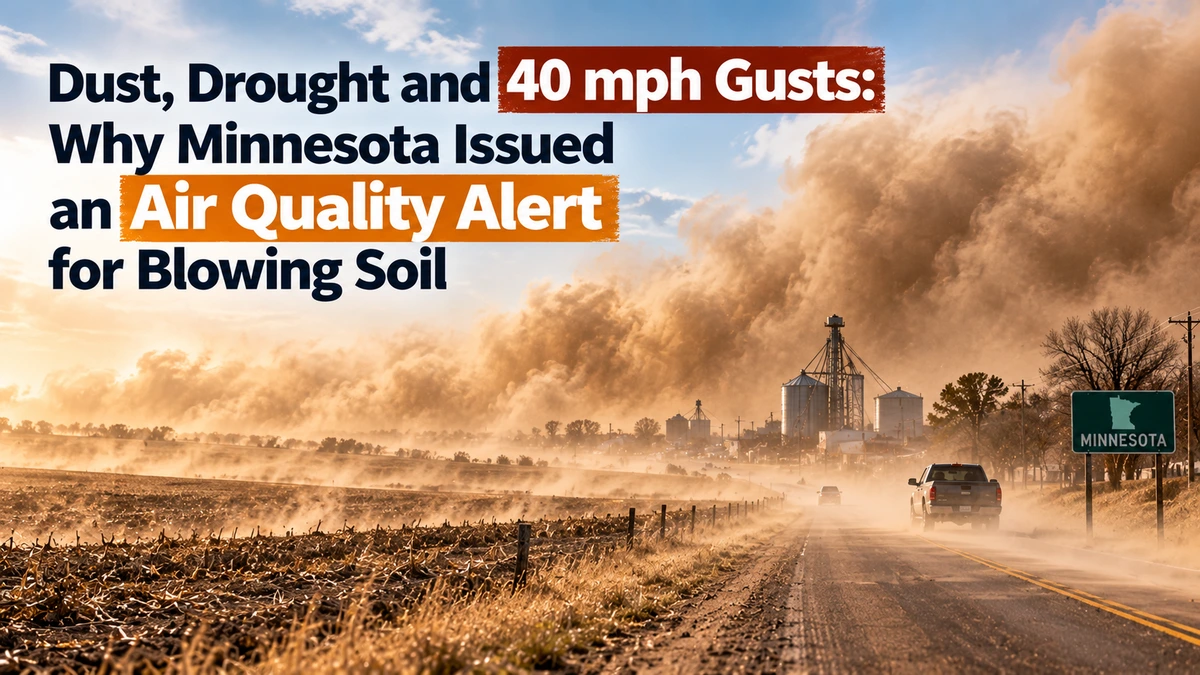
On Saturday, October 10, parts of west-central and southwestern Minnesota were under an air quality alert, and there wasn’t a wildfire or factory fire anywhere near it. The culprit was plain old soil: dry ground, a drought, and southerly wind gusts the Minnesota Pollution Control Agency (MPCA) said could top 40 mph.
What happened
The MPCA issued the alert for Saturday from 7 a.m. to 7 p.m. CDT. It covered towns including Marshall, Worthington and Ortonville, plus the Upper Sioux Community. Air quality was forecast to reach the orange level, “unhealthy for sensitive groups.” The agency tied the event to unseasonably warm weather (highs near 88°F in the Twin Cities, and possibly low 90s in the southwest) and strong winds blowing across dry soil in a drought area.
The MPCA expected the winds to ease through the evening, which would lessen the impact.
Why dust counts as air pollution
The pollutant here was PM10, the name for particles 10 micrometres across or smaller. For scale, that’s roughly a fifth to a seventh the width of a human hair. These “coarse” particles come from soil, road dust and similar material. They’re bigger than the PM2.5 specks from smoke and exhaust, so your nose and throat catch more of them. But plenty still get into your lungs.
Think of it like a sandbox on a windy day. Calm air leaves the sand where it is. Strong gusts over dry, loose ground lift it into the air, and it stays there until the wind drops.
Why the weather mattered
- Dry ground: Moist soil clumps together and resists the wind. Drought-parched soil doesn’t.
- Warm air: Unusually warm days help dry the surface further and stir the air near the ground.
- Gusts above 40 mph: Faster wind lifts heavier grains and carries them further.
What this means for you
The MPCA’s advice for the alert period is practical and applies to any dust event:
- People with asthma, COPD, heart disease, high blood pressure or diabetes, plus children, older adults and pregnant people, should spend less time outdoors and skip strenuous activity.
- Keep windows shut and set your car or home ventilation to recirculate.
- Expect hazy skies, dust settling on surfaces, and reduced visibility on the road.
Symptoms to watch for include coughing, chest tightness, wheezing, shortness of breath and fatigue.
Where this fits in the bigger picture
AQI isn’t only a smoke-and-traffic story. In places with dry soil, wind alone can push the index into the unhealthy range, and the alert came after a larger dust event in May, when parts of the Minnesota and North Dakota border region were forecast to reach the red level. The same physics applies in Rajasthan, the Gulf and the Sahel: dry ground plus strong wind equals PM10.
Data visualization idea
A simple line chart pairing hourly wind gusts with hourly PM10 readings from a Marshall-area monitor would show the link clearly: the dust rises when the gusts do and falls when they ease. A second panel could shade drought-affected counties on a map.
Bottom line
A clear, sunny day can still carry unhealthy air if the wind is strong and the soil is dry. When a dust alert is issued, treat it like any other AQI warning, and check your local monitor before heading out.
Related reading
- PM2.5 vs PM10: what’s the difference and which matters more for your health
- Ventilation index explained: why calm days trap smog over your city
- How air quality monitoring stations really work
Sources
- FOX 9: Minnesota weather: Air quality alert issued for Saturday due to blowing dust (citing the MPCA), Oct. 9, 2026
- FOX 9: Blowing dust triggers air quality alert for parts of Minnesota (May 2026)
- AirNow.gov: US air quality index and alerts
Written by Dr. Lukas Müller, Ph.D. Atmospheric Sciences, specialising in atmospheric chemistry and air pollution. Researched and fact-checked against primary and official sources, and reviewed by the AQI World editorial team. Last updated: October 13, 2026.


