



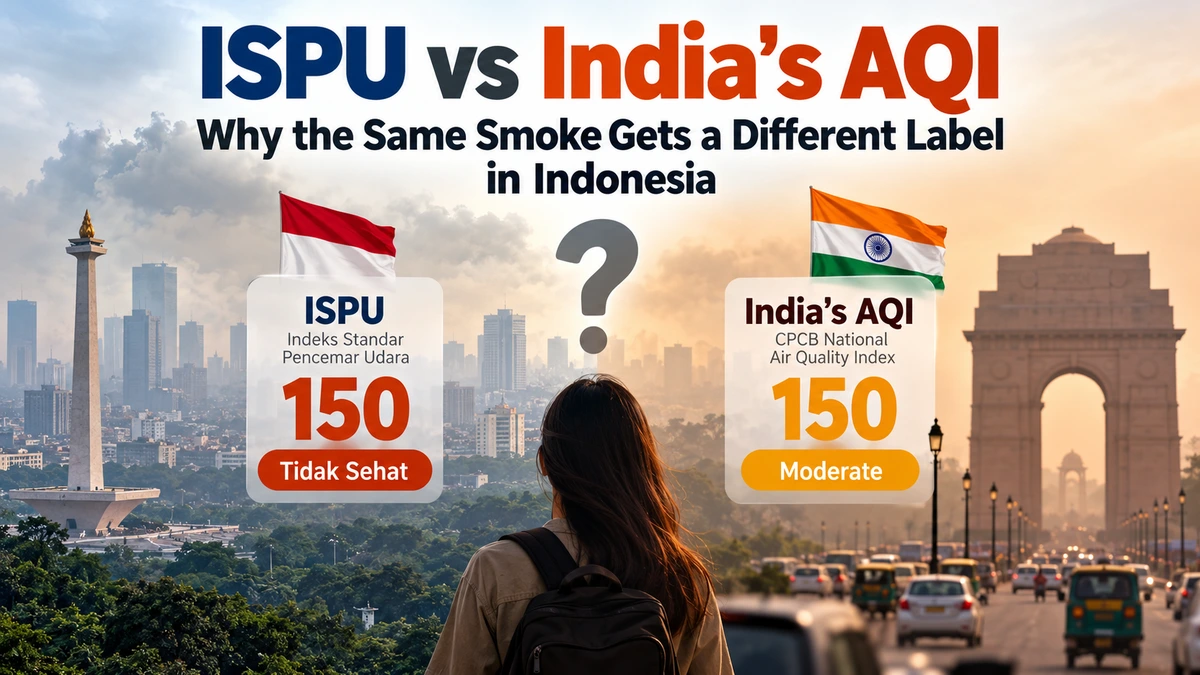
When Indonesia’s haze makes the news, the headlines quote a number called ISPU. If you’re used to India’s AQI, that number can mislead you: the same smoke gets a different label depending on which scale is reading it. Here’s how Indonesia’s index works, and how to translate it.
What ISPU Is
ISPU (Indeks Standar Pencemar Udara, or Air Pollutant Standard Index) is Indonesia’s official air quality index. It’s set by the Minister of Environment and Forestry Regulation No. 14 of 2020, which replaced an older 1997 decree. The big change in the 2020 version was adding PM2.5, the fine particles that dominate smoke from forest and peat fires. Before that, PM2.5 wasn’t part of ISPU at all.
It now covers seven pollutants: PM2.5, PM10, nitrogen dioxide, sulphur dioxide, carbon monoxide, ozone and hydrocarbons. As a rule, an index like this is driven by whichever pollutant scores worst at that moment, so during fire season the headline number is almost always about particles.
The Five ISPU Categories
ISPU sorts readings into five tiers: Baik (Good) at 0 to 50, Sedang (Moderate) at 51 to 100, Tidak Sehat (Unhealthy) at 101 to 200, Sangat Tidak Sehat (Very Unhealthy) at 201 to 300, and Berbahaya (Hazardous) above 300.
Same Number, Different Label
India’s national AQI, run by the Central Pollution Control Board (CPCB), uses six tiers and tops out at 500. Put the two side by side and the labels stop lining up:
ReadingIndonesia (ISPU)India (CPCB AQI)
0 to 50GoodGood
51 to 100ModerateSatisfactory
101 to 200UnhealthyModerate
201 to 300Very UnhealthyPoor
Above 300HazardousVery Poor (301 to 400), Severe (401 to 500)
Data source: Indonesian Ministry of Environment and Forestry Regulation P.14/2020; CPCB National Air Quality Index.
The practical gap sits in the middle. A reading of 150 is “Moderate” in India but “Unhealthy” in Indonesia. Neither is wrong. They draw the lines in different places, so you can’t compare the words, only the numbers, and even then only with care.
Why This Matters During Haze Season
ISPU’s top tier is open-ended: anything above 300 is Hazardous. That’s why Indonesian reports during severe fire episodes can quote numbers far past anything India’s capped 0 to 500 scale would show. A very high ISPU figure tells you conditions are dangerous. It doesn’t tell you how far past the line you are in a way you can set against an Indian reading.
It’s also worth knowing that ISPU is an information index, not a legal limit. Indonesia’s separate ambient air quality standards, set in government regulation, are what pollution rules are enforced against.
What This Means for You
- Reading Indonesian haze news: check which scale a number comes from before comparing it to your own city. An ISPU of 150 and an Indian AQI of 150 are not the same label.
- Travelling to Indonesia, Malaysia or Singapore in fire season: look at the PM2.5 reading itself, not just the category name, and treat “Unhealthy” on ISPU as the point to cut outdoor time and wear a well-fitted N95-type mask.
- Using an international app: many apps convert local readings to their own scale, so the number on your screen may not match what Indonesian authorities published.
Written by Dmitri Volkov, B.Sc. Environmental Science, who works in environmental monitoring and air quality data interpretation. This article was researched and fact-checked against the cited sources below and reviewed by the AQI World editorial team. Last updated: October 12, 2026.


