


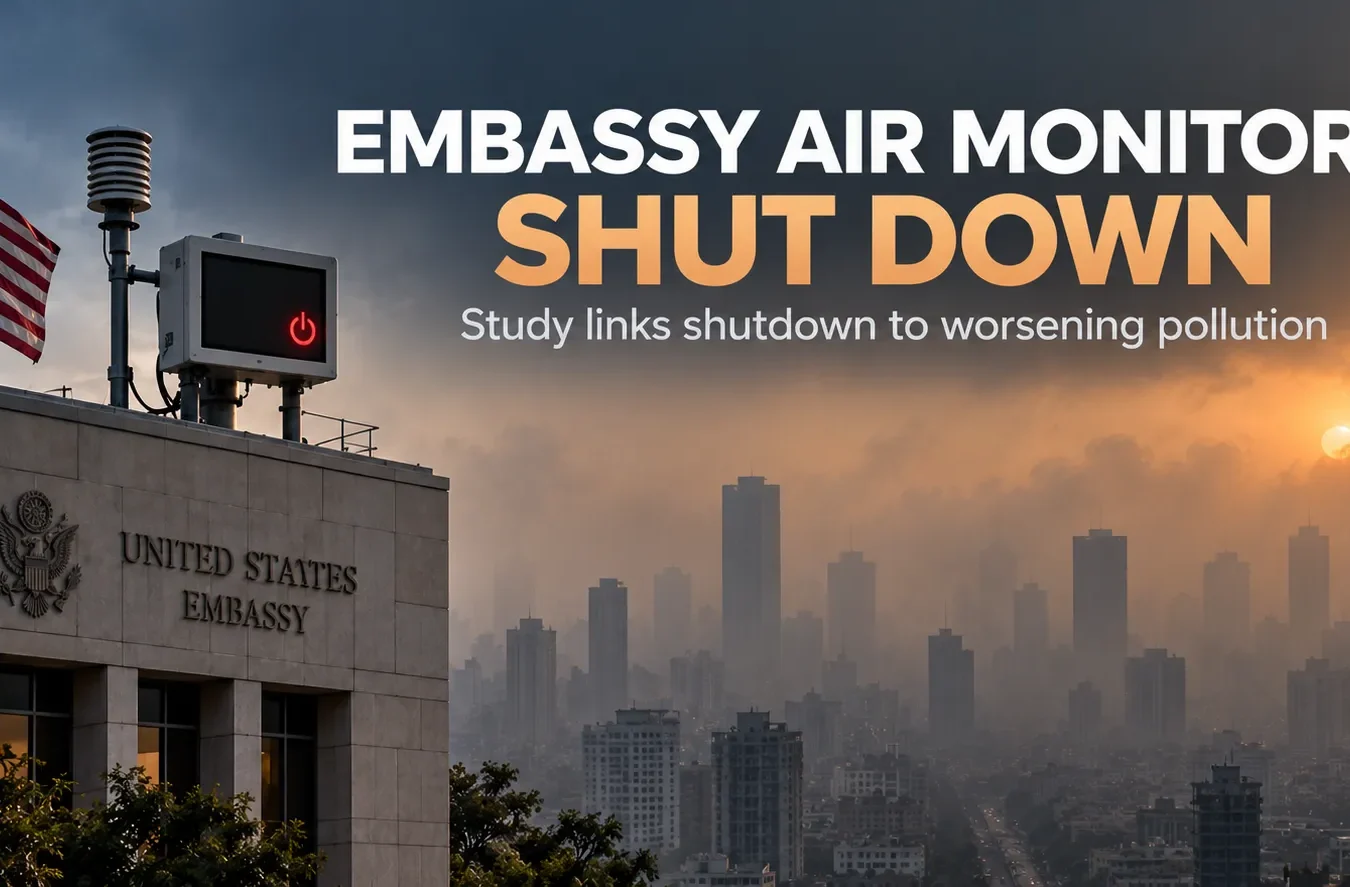
For more than a decade, US embassies and consulates ran their own PM2.5 monitors and published the readings publicly — a quiet but influential source of independent air-quality data in cities where governments didn’t always report their own numbers. In March 2025, the State Department shut the program down, citing budget constraints. A study published in the Proceedings of the National Academy of Sciences (PNAS) on September 14, 2026 has now measured what that shutdown actually cost: pollution went up.
What the program did, and why it stopped
The monitoring effort began in 2008, when the US Embassy in Beijing installed a rooftop PM2.5 sensor and started tweeting the readings — reporting later credited with pushing China toward tougher air-quality policy. By the time it was cut, the program had grown to more than 80 embassies and consulates worldwide, with data published on the EPA’s AirNow site and the State Department’s ZephAir app. India’s US Embassy in New Delhi and its consulate in Mumbai were both part of the network; both stopped reporting when the program was suspended on March 4, 2025.
What the new study found
Researchers Zoey Yiyuan Zhou (Columbia University), Eric Zou (University of Michigan), and Andrea La Nauze (Deakin University) compared satellite-measured pollution across 46 cities before and after their embassy monitors went dark. They found air pollution levels rose 24-33% in the months following the shutdown, which they estimate translates to roughly a 4% rise in ground-level PM2.5. The increase peaked three to four months after monitoring ended, and cities with fewer alternative data sources — including Manila, Yangon (Rangoon), and Vientiane — saw the sharpest spikes.
The mechanism the researchers point to is behavioral, not physical: once the public stopped seeing daily readings, some of the pressure that kept local pollution controls in place eased off. “Data is just so important,” Zhou told NPR. “Having access to information is necessary to make sure that these previous gains can continue.”
The program was cheap, relative to what it caught
A separate 2022 analysis by researchers at Carnegie Mellon University and the University of Queensland had already found the embassy monitors saved a median host city an estimated $127-465 million a year in avoided health costs and 303-895 premature deaths, against a running cost of under $10,000 per monitor annually. The State Department says it’s “restoring public reporting” but hasn’t given a timeline.
What this means for you
- If you tracked AQI in Delhi, Mumbai, Beijing, or Manila through AirNow or ZephAir, that feed has been dark since March 2025 — switch to CPCB’s national AQI portal, aqicn.org, or IQAir for those cities instead.
- A gap in official monitoring doesn’t mean pollution improved — the study’s finding is the opposite: less visibility corresponded with worse air, not better.
- This is a reminder to check your source’s update date, not just its reading — a monitor that stopped updating a year ago can still show a plausible-looking number on some aggregator pages.
Data to watch
A world map marking the 46 study cities, shaded by their percentage pollution increase after monitoring stopped, with Manila, Yangon, and Vientiane called out at the high end.
A before/after timeline of satellite-estimated PM2.5 for one affected city, with a marker at the March 2025 shutdown date and the 3-4 month peak highlighted.
The embassy program was never a substitute for a country’s own monitoring network — it was a backstop, and a cheap one. This study is the first hard evidence of what happens when that backstop disappears: not just a data gap, but measurably dirtier air.
Related reading
- How AQI numbers differ by country
- What is PM2.5 and why it matters most
Sources
- NBC News. (2025). U.S. embassies end air pollution monitoring that spurred China and others to action.
- NPR / KUOW. (2026, September 15). Air pollution spiked after the Trump administration stopped embassy monitoring.
- U.S. Embassy & Consulates in India. Air Quality Data Information.
- NPR / WUSF. (2026, September 15). Air pollution spiked after the Trump administration stopped embassy monitoring — reporting on the PNAS study by Zhou, Zou, and La Nauze.
- Centre for Research on Energy and Clean Air. U.S. embassy AQ data halt: Ramped up government monitoring could save hundreds of millions of dollars per city, citing the 2022 Carnegie Mellon University / University of Queensland cost-benefit analysis.
This post was researched and fact-checked against the sources listed above, including direct NPR reporting on the September 2026 PNAS study. It’s reviewed by our editorial team before publishing, and we’ll update it if the State Department announces a restoration timeline.