


By Dr. Ananya Sharma, Ph.D. Environmental Science (Air Pollution & Urban Air Quality). Researched and fact-checked against primary sources and reviewed by our editorial team. Last updated: October 8, 2026.
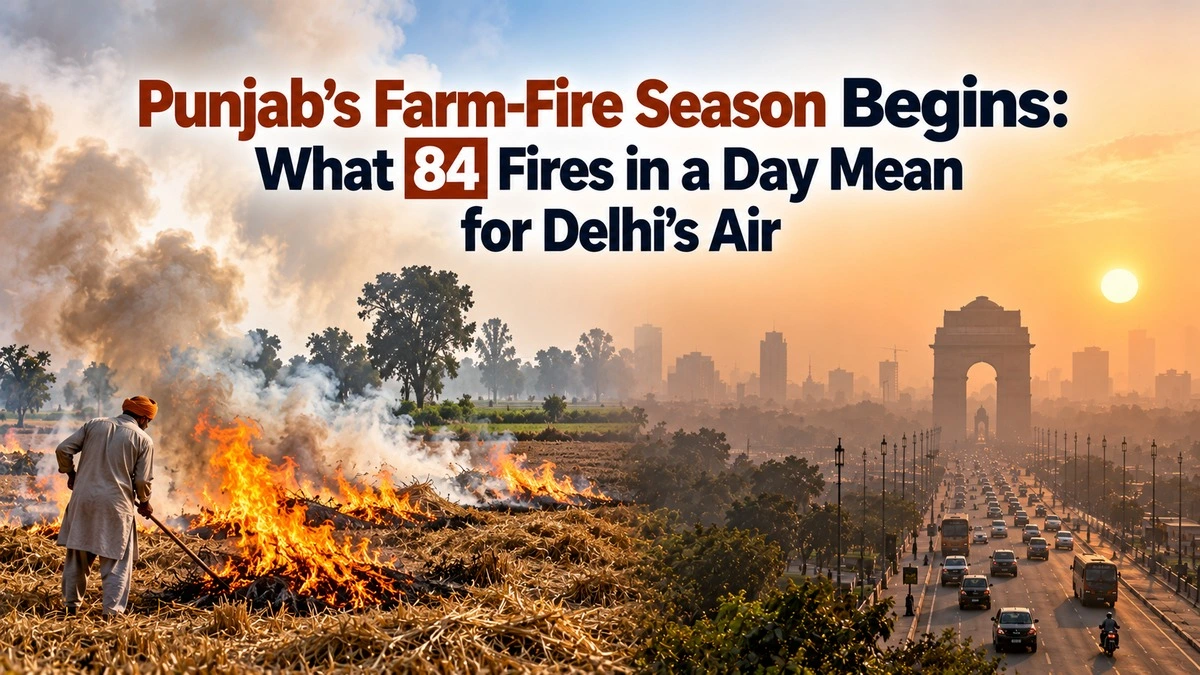
Punjab’s farm-fire season is under way, and the first numbers are in. A Commission for Air Quality Management (CAQM) monitoring report logged 84 farm fires in a single day in early October. Delhi’s AQI stood at 187 the same week, with 15 stations in the ‘Poor’ category. Here’s what those numbers do and don’t tell you.
What the early-October numbers show
According to the CAQM report, as covered by NewsDrum, Punjab saw 84 fire detections. Amritsar had 49 and Tarn Taran 18, with Ferozepur at 5. Officials inspected 78 of them and confirmed crop-residue burning at 30 locations. For comparison, the same report put the count at 95 on October 4, 2025, so this year’s start is running slightly below last year’s.
Think of the 84 as a smoke-detector count, not a fire-department count. Satellites flag a heat spot, and then someone has to drive out and check it. Some spots turn out to be something else, like a brick kiln or a field already burned earlier. That’s why 84 detections became 30 confirmed burnings.
What officials did about it
- 36 warning or show-cause notices
- 13 ‘red entries’ in farmers’ land records, which can limit access to loans and land sales
- 1 FIR (police case), in Patiala district
- Rs 1.40 lakh in environmental compensation imposed, of which Rs 55,000 has been recovered
The recovery gap is worth watching. A fine only works as a deterrent if it’s collected.
Why this season could still ramp up
Monitoring runs from September 15 to November 30. Early counts are small because most paddy hasn’t been harvested yet. The Tribune reported that Punjab has 32.75 lakh hectares under paddy this year, which leaves about 19.5 million tonnes of straw to clear before wheat sowing. The state plans to supply roughly 7,500 straw-management machines and 6,500 super seeders to help farmers clear fields without fire.
Farmers have a short window between harvest and wheat sowing. When machines are scarce or costly, fire is the fast option. That’s the real driver, more than any lack of awareness.
Why Delhi’s air is only part of this story
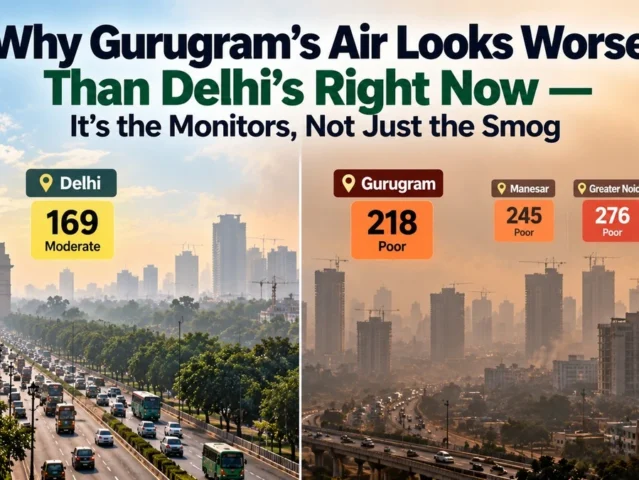
Delhi’s AQI of 187 is ‘Moderate’, close to the edge of ‘Poor’. Farm smoke is only one input. Local traffic, construction dust and weather matter too. Early in the season the effect is mild, but smoke from Punjab and Haryana typically becomes more noticeable as fires peak and winds slow down.
What this means for you
- In Delhi-NCR: Check the CPCB’s official AQI each morning. If it climbs into ‘Poor’, move outdoor exercise to the afternoon, when air mixes better.
- If you have asthma or heart disease: Keep inhalers and medicines stocked now, before the peak.
- At home: Close windows during heavy-smoke hours and consider a purifier in the bedroom.
- In Punjab’s farm districts: Smoke affects villages first. Children and older relatives should stay indoors on smoky evenings.
Chart ideas
A line chart comparing Punjab’s daily fire detections from September 15 through November 30 for this year and last year would show whether the season is running early, late or on pace. A second chart could place the detections next to the confirmed cases to show how many alerts turn out to be real burnings.
The bottom line
The season has started a little below last year’s pace, but the peak is still ahead. Watch the confirmed-case count and whether fines are actually collected. They tell you more than the daily headlines.
Related reading: Haryana’s Parali Protection Force; How to read India’s AQI categories; What GRAP stages mean.