By Dr. Ananya Sharma, Ph.D. Environmental Science (Air Pollution & Urban Air Quality) · Last updated: 27 September 2026
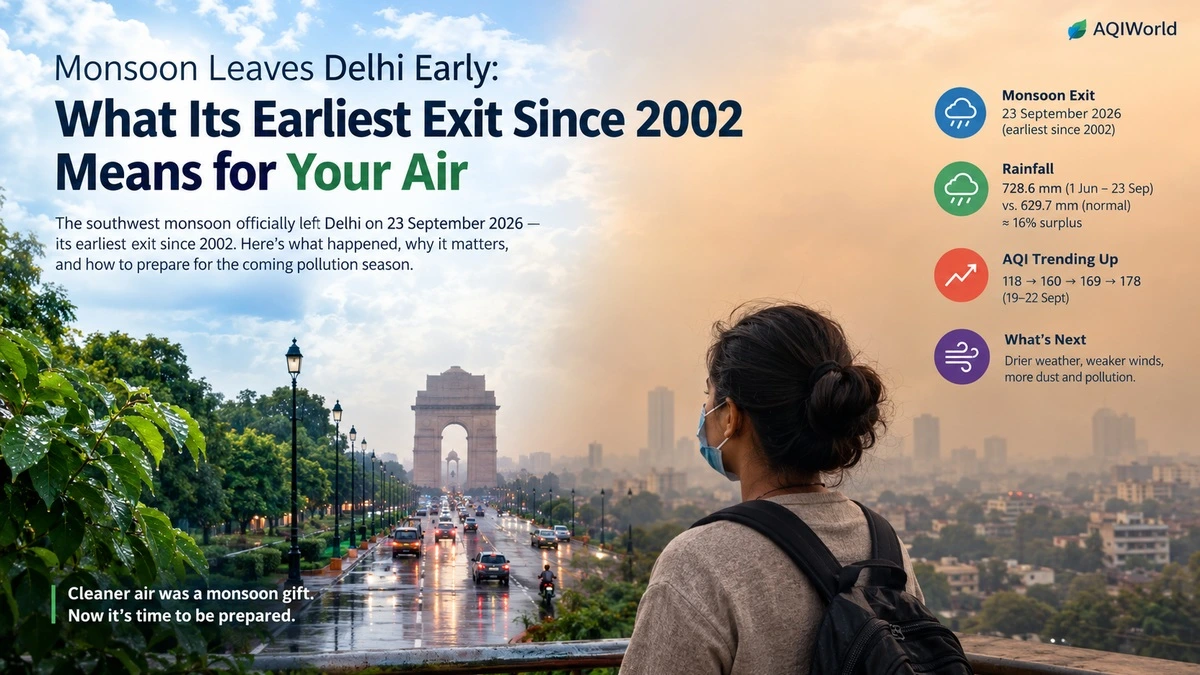
The southwest monsoon officially left Delhi on 23 September 2026. That’s two days earlier than the city’s normal withdrawal date and, according to reporting on India Meteorological Department (IMD) records, the earliest exit since 2002. For anyone who breathes Delhi’s air, the date matters more than it sounds: the monsoon is the city’s most reliable air cleaner, and its departure opens the door to the long post-monsoon pollution season.
What happened this week
IMD declared the monsoon’s withdrawal from parts of West Rajasthan on 19 September, pushed it back across Punjab and Haryana on 21 September, and on 23 September announced it had withdrawn from the entire Delhi region, along with most of Punjab, Haryana and Rajasthan and parts of Uttar Pradesh and Gujarat.
It wasn’t a dry season. Safdarjung, Delhi’s reference weather station, logged 728.6 mm of rain from 1 June, against a normal of 629.7 mm. That’s a surplus of about 16%.
The air quality numbers are already moving
Even before the official announcement, Delhi’s air was getting worse as rainy days thinned out. Daily average AQI readings reported from official monitoring data looked like this:
Date (Sept 2026)24-hour average AQICategory
19 September118Moderate
20 September160Moderate
21 September169Moderate
22 September178Moderate
All four days stayed within India’s “Moderate” band (101–200), but the direction is clear: a 60-point climb in three days. A simple line chart of Delhi’s daily AQI from mid-September through October would show this pattern well: a flat, low stretch during active rain, then a steady staircase upward once the monsoon exits.
Why the monsoon’s exit matters so much
Think of monsoon rain as a daily rinse cycle. Raindrops pull dust, smoke and fine particles out of the air and drop them on the ground. Humid, windy monsoon weather also keeps the air well mixed, so pollution doesn’t pile up near the surface.
When the monsoon leaves, three things change at once:
- The rinse stops. Dust from roads and construction, and exhaust from traffic, stays suspended for longer.
- Winds get weaker and shift. Post-monsoon winds over north India tend to be calmer, and from October they often come from the northwest, the direction of the Punjab and Haryana farmlands where crop residue is burned after the rice harvest.
- Nights get cooler. As autumn advances, cool air near the ground can get trapped under warmer air above it, acting like a lid that holds pollution close to where we breathe.
None of this means a smog crisis is imminent. Early withdrawal doesn’t guarantee a worse winter, and isolated showers are still possible. But it does mean Delhi’s natural cleaning is winding down earlier than usual.
What this means for you
- Start checking the AQI daily. Use the CPCB’s official national AQI portal or the SAFAR forecast, and pay attention to the trend, not only today’s number.
- Plan exercise for cleaner hours. On days above 150, lighter outdoor activity is sensible for children, older adults and people with asthma or heart conditions.
- Get your indoor setup ready now. If you use an air purifier, replace the filter before October rather than in the middle of a bad-air week.
- Know the GRAP stages. The Commission for Air Quality Management (CAQM) brings in restrictions under the Graded Response Action Plan when AQI reaches “Poor” (201+). Stage I is usually the first sign the season has turned.
The bottom line
Delhi had a generous monsoon, and its early exit ends that relief sooner than usual. Numbers were already heading up in the days just before withdrawal. The next four to six weeks will show whether calm autumn weather and farm fires push the city into “Poor” territory early. Watching the daily trend is the best way to stay ahead of it.
Related reading: how to read India’s AQI categories; why stubble burning peaks in October and November; what GRAP Stage I actually restricts.
Sources
- India Meteorological Department (IMD): monsoon information
- Outlook India: Delhi sees earliest monsoon withdrawal since 2002 (23 Sept 2026)
- The Tribune: Monsoon exits Delhi after 16% surplus rain
- Business Standard: Delhi to stay dry as monsoon withdraws
- CPCB: National Air Quality Index
- Commission for Air Quality Management (CAQM)
This article was researched and fact-checked against official IMD and CPCB information and published news reports, and reviewed by our editorial team.