



By Dr. Ananya Sharma, Ph.D. Environmental Science (Air Pollution & Urban Air Quality). Researched and fact-checked against the sources listed below and reviewed by our editorial team. Last updated: October 12, 2026.
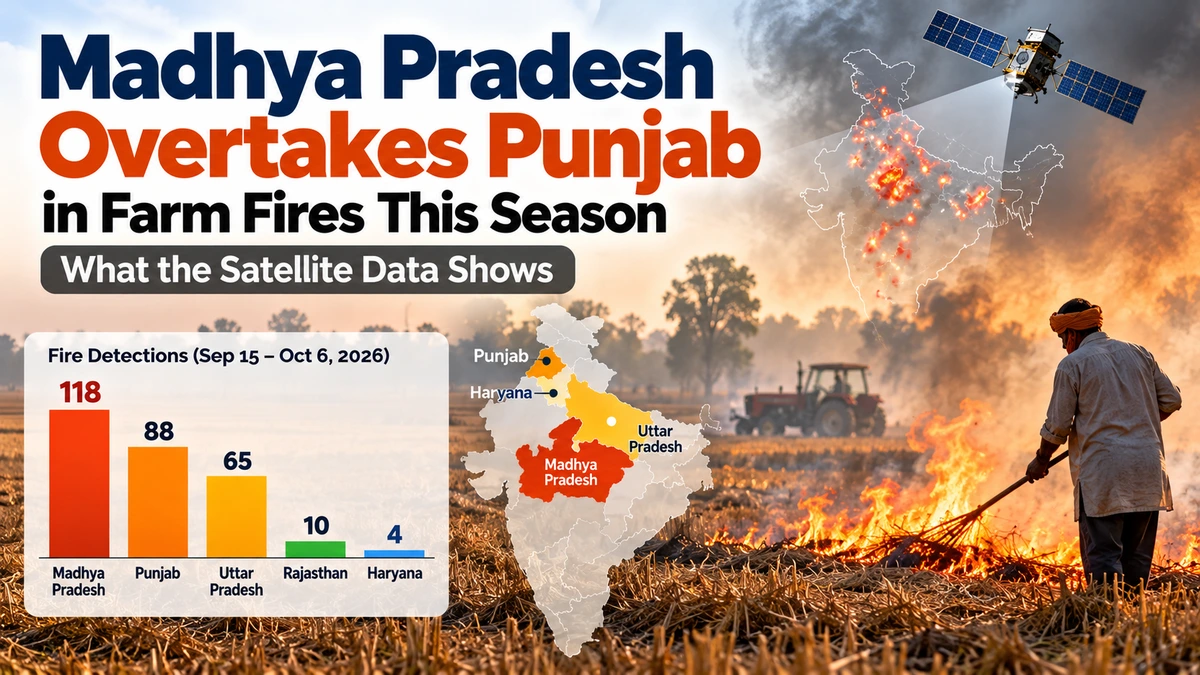
For years, “stubble burning” has meant Punjab and Haryana in the public mind. This season’s satellite count tells a different story: Madhya Pradesh has logged more crop-fire detections than Punjab so far, and Punjab’s tally is the lowest it’s been for this stretch in seven years.
What the numbers show
A bulletin released on October 6 by CREAMS, the satellite-monitoring group at the Indian Agricultural Research Institute (IARI), counted 287 burning incidents across seven states between September 15 and October 6, 2026. Here’s how the leading states stack up:
StateFire detections, Sep 15 to Oct 6, 2026
Madhya Pradesh118
Punjab88
Uttar Pradesh65
Rajasthan10
Haryana4
On October 6 alone, the satellites recorded 33 incidents. Madhya Pradesh accounted for 24 of them, roughly three-quarters of the day’s total. Punjab had four, Uttar Pradesh two and Haryana none. Punjab hasn’t hit double digits on any single day this season, while Madhya Pradesh has done so on five days.
Why Madhya Pradesh is rising
Experts quoted in Down To Earth’s coverage link the shift to changing farming patterns. Farmers who once grew soybean, black gram and other kharif crops are moving toward paddy, because extreme weather makes the older crops riskier. After a paddy harvest, there’s a short window before the next crop goes in, and burning the leftover straw is the quickest, cheapest way to clear the field. The report describes Madhya Pradesh as following Punjab’s path.
The state was already the biggest contributor last year. Across September 15 to November 30, 2025, CREAMS counted 33,028 fires in six states, and Madhya Pradesh made up 17,067 of them, over half. Punjab had 5,114.
Read the data with care
- Early-season counts are small. Peak burning in north India usually comes later in October and November, so these numbers describe the opening weeks, not the full season.
- Clouds hide fires. The bulletin notes that cloud cover over parts of Madhya Pradesh, Uttar Pradesh and Uttarakhand can hinder detection, so real counts may be higher.
- Different sources, different totals. Another monitoring report put Punjab at 84 fires as of October 5, against 88 here. These come from different tools and cut-off dates, so don’t add them together.
What this means for you
Delhi’s October air depends mostly on nearby sources and local weather: wind speed, morning temperature layers and the PM10 dust that has been the main pollutant on recent bulletins. A fire in Madhya Pradesh sits much farther from the capital than a fire in Punjab or Haryana, so its smoke matters less for Delhi on any given day. But it adds to the regional haze across central and northern India, and it shows the crop-residue problem is spreading beyond the states we usually watch.
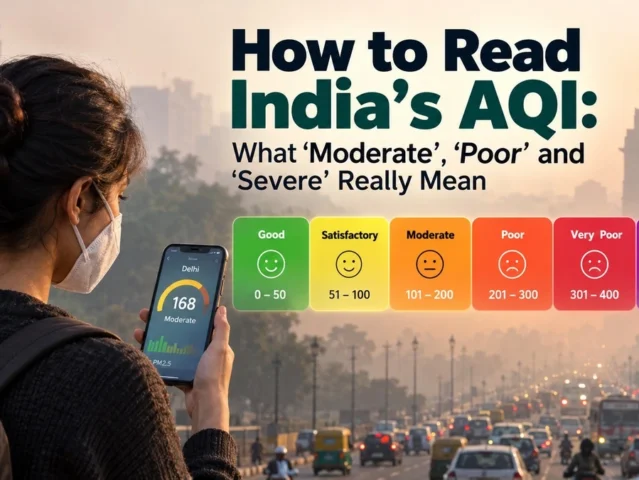
If you live in north or central India, check your local AQI each morning during October and November, keep windows closed during early-morning smoke spells, and use a well-fitted N95 mask outdoors on poor-air days.
Chart ideas
A simple bar chart ranking states by fire count for September 15 to October 6 would make the Madhya Pradesh lead obvious at a glance. A second chart could compare each state’s share of last season’s 33,028 fires with this season’s early share.
The bottom line
Punjab’s early-season drop is real good news, but the problem hasn’t gone away; part of it has moved. Watch the weekly satellite bulletins as the harvest peaks.
Related reading
- Punjab’s farm-fire season begins: what 84 fires in a day mean for Delhi
- India’s monsoon fell short: what it means for winter air
- N95 vs surgical vs cloth masks for smog