



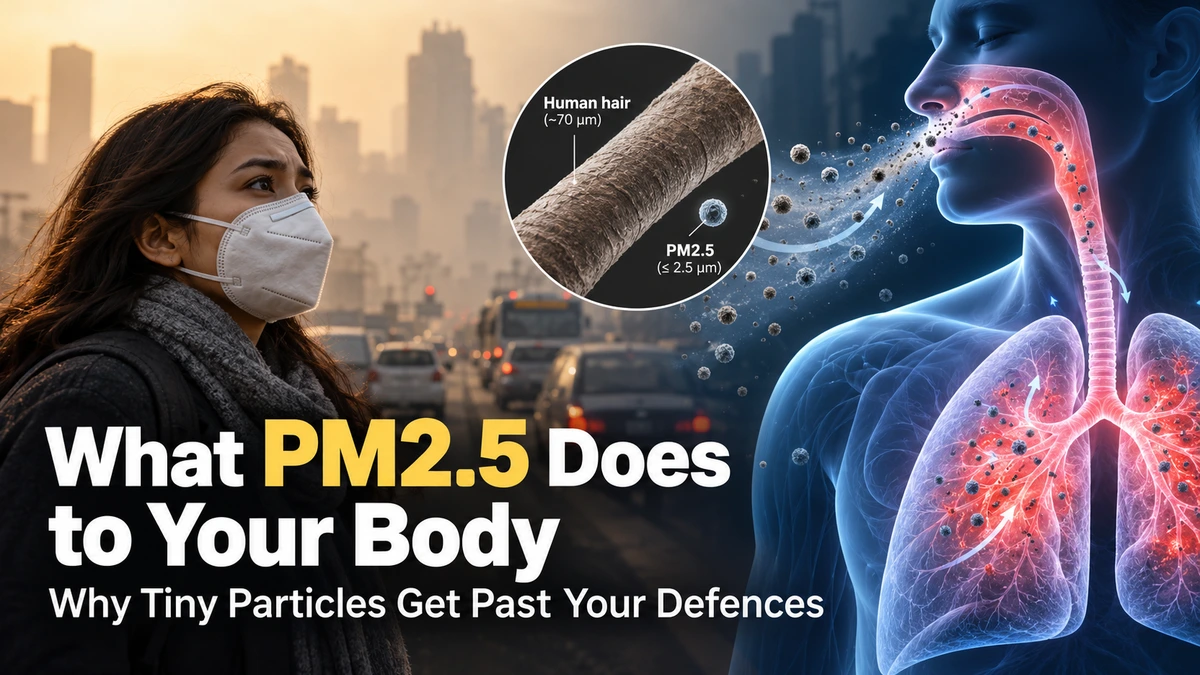
Most people know PM2.5 is bad for them. Fewer know why. It comes down to size: these particles are so small that your body’s usual defences can’t stop them.
By Dr. Ananya Sharma, Ph.D. Environmental Science (Air Pollution & Urban Air Quality), New Delhi. Researched and fact-checked against primary sources and reviewed by our editorial team. Last updated: 11 October 2026.
What PM2.5 actually is
PM2.5 is the name for particles 2.5 micrometres across or smaller. A human hair is roughly 30 times wider than the biggest of them. They come from vehicle exhaust, burning crops and rubbish, power plants, construction, and cooking fires. Some are formed in the air itself when gases from those sources react.
Why size matters so much
Think of your nose and throat as a doormat and a coarse sieve. They catch big dust and pollen well. PM2.5 slips past both. The WMO describes these particles as able to reach deep into the lungs and even the bloodstream, which is how a lung-level problem becomes a whole-body one.
What it does inside you
- Lungs: irritation, coughing, worse asthma, and a higher risk of infections and long-term lung disease (COPD).
- Heart and blood vessels: long-term exposure raises the risk of heart attack and stroke. The WHO attributes about 68% of outdoor-pollution deaths to heart disease and stroke.
- Cancer: about 4% of those deaths were from lung cancer.
The WHO estimates outdoor air pollution caused around 4.2 million early deaths worldwide in 2019, and about 6.7 million when indoor household pollution is included. Roughly 89% of the outdoor deaths happened in low- and middle-income countries.
How the safe limits compare
Standard24-hour limitYearly average limit
WHO guideline (2021)15 µg/m³5 µg/m³
India’s national standard (CPCB)60 µg/m³40 µg/m³
So India’s daily legal limit is four times the WHO guideline, and its yearly limit is eight times higher. WHO says 99% of the world’s population lived in places that missed its guideline levels in 2019, and that includes cities in many countries, not just India. Meeting the national standard is a legal milestone; it isn’t the same as the air being healthy.
Who is hit hardest
Children, whose lungs are still developing; older adults; pregnant women; and anyone with asthma or heart disease. Outdoor workers such as traffic police and delivery riders get the most exposure, with the least protection.
What this means for you
- Check PM2.5 specifically, not just the headline AQI number, because it’s the pollutant that matters most for health.
- Wear a well-fitted N95 on high-pollution days if you must be outside. A loose cloth mask does little against PM2.5.
- Shift hard exercise indoors or to cleaner hours when levels are high.
- Use a HEPA purifier in the room where you sleep, and keep windows shut during smoky evenings.
- Don’t add to it indoors: avoid burning incense or mosquito coils in closed rooms when air outside is already poor.
Data-viz ideas
A bar chart with three bars (WHO daily limit, India daily limit, and a typical Delhi winter day) would make the gap hard to miss. A simple diagram showing a hair next to a PM2.5 particle would give readers a feel for the scale.
The bottom line
PM2.5 matters because it gets past your body’s filters. You can’t always control the air, but you can watch the right number and cut your exposure on the worst days.
Related reading
- PM2.5 vs PM10: what’s the difference?
- How to read India’s AQI categories
- Do air purifiers actually work?


