



By Dr. Ananya Sharma, Ph.D. Environmental Science (Air Pollution & Urban Air Quality), New Delhi. Last updated: 15 October 2026.
Every winter, many of us face the same question at 6 am: go for the run or skip it? Exercise is one of the best things you can do for your heart and lungs. But on a smoggy morning, you’re also pulling far more polluted air deep into your body. The good news is that you rarely have to choose all or nothing. Here’s how to decide.
Why exercise changes the picture
At rest, you breathe gently through your nose, which filters out some larger particles. During a brisk run or a hard cycle, you breathe several times more air every minute, and mostly through your mouth. That means more fine particles (PM2.5) skip the nose’s filter and travel deep into the lungs. A 30-minute run on a “Poor” day can expose you to as much pollution as several hours of sitting quietly in the same air.
What the research says
A widely cited 2016 study led by researchers at the University of Cambridge modelled the trade-off between the benefits of exercise and the harm from pollution. Even at Delhi’s very high pollution levels, it estimated that the benefits of cycling outweighed the risks for about the first 30 minutes a day. Beyond about 45 minutes a day, the pollution risk began to win. In most cities around the world, the break-even point came only after many hours.
So skipping exercise for weeks every winter is usually worse for you than moving sensibly. On high-AQI days, timing and intensity are what matter most.
A simple guide by AQI category
This guide uses India’s national AQI categories and the CPCB’s health advisories for each one.
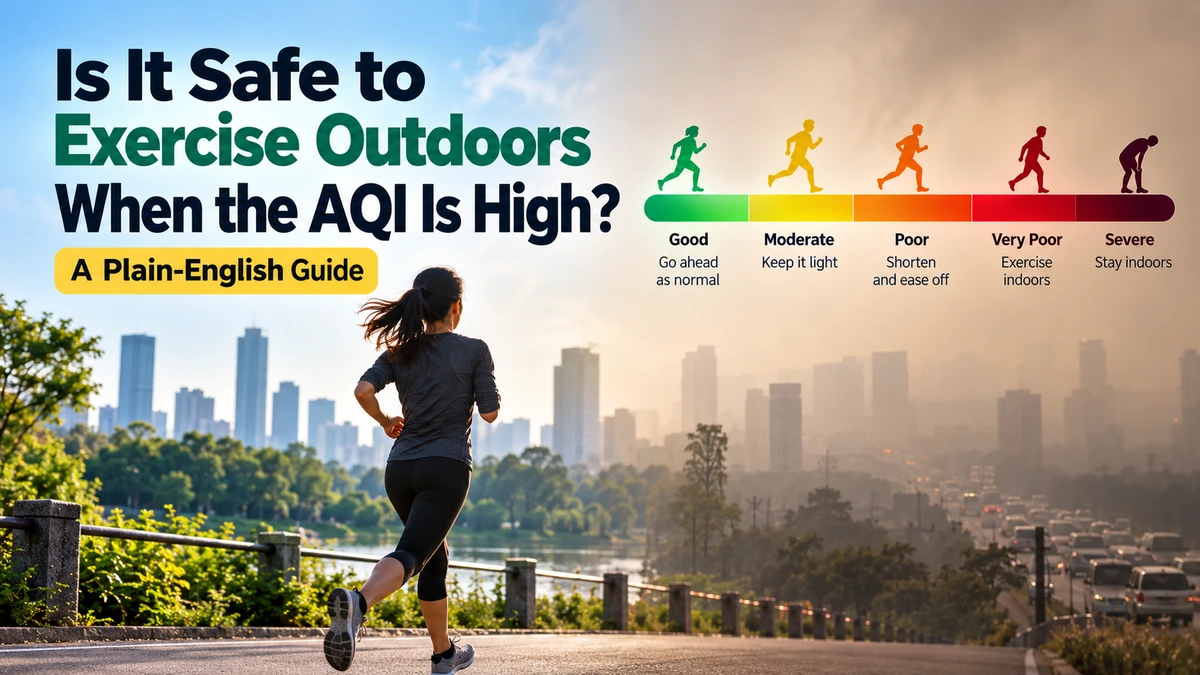
India AQICategoryOutdoor exercise
0–100Good / SatisfactoryGo ahead as normal.
101–200ModerateFine for most people. If you have asthma or a heart condition, keep it light and carry your inhaler.
201–300PoorShorten and ease off. Swap a long run for a brisk walk, or move the workout indoors.
301–400Very PoorExercise indoors. Avoid hard outdoor sessions.
401–500SevereStay indoors. Even healthy people are affected.
A useful graphic here would be a colour-coded AQI bar, from green to maroon, with a running-shoe icon that shrinks as the bar moves into the red. It’s an easy reminder to scale down rather than stop.
What this means for you
- Check before you lace up. Look at the live AQI for your nearest station, not yesterday’s city average.
- Pick your hour. In North Indian winters, early mornings and late evenings are often the worst, because cold, still air traps smog near the ground. Early to mid-afternoon is usually cleaner.
- Pick your route. Stay away from busy roads. Pollution from traffic exhaust drops noticeably even a short distance from the kerb.
- Dial down intensity. A steady walk means far less heavy breathing than intervals or sprints.
- Be wary of masks during hard workouts. An N95 protects you on a walk, but it makes heavy breathing harder. On bad days, exercising indoors is usually the better swap.
- Know your warning signs. Stop if you notice chest tightness, wheezing, unusual breathlessness or a cough that won’t settle.
Children, older adults, pregnant women and anyone with lung or heart disease should switch to indoor activity sooner, from the upper end of “Moderate”.
The bottom line
Keep moving through the smog season, just do it smarter. Check the number, choose cleaner hours and routes, ease off as the AQI climbs, and take it indoors once the air turns “Very Poor”.
Related reading: how to read India’s AQI categories; N95 vs surgical vs cloth masks for smog.
Sources
- Tainio et al. (2016), “Can air pollution negate the health benefits of cycling and walking?”, Preventive Medicine
- University of Cambridge: Walking and cycling good for health even in cities with higher levels of air pollution
- CPCB National Air Quality Index (categories and health statements)
- AirNow (US EPA): AQI Basics and activity guidance
- WHO Global Air Quality Guidelines (2021)
This article was researched and fact-checked against the primary sources listed below and reviewed by our editorial team. Figures are as reported on the dates shown and may change as new data comes in.


