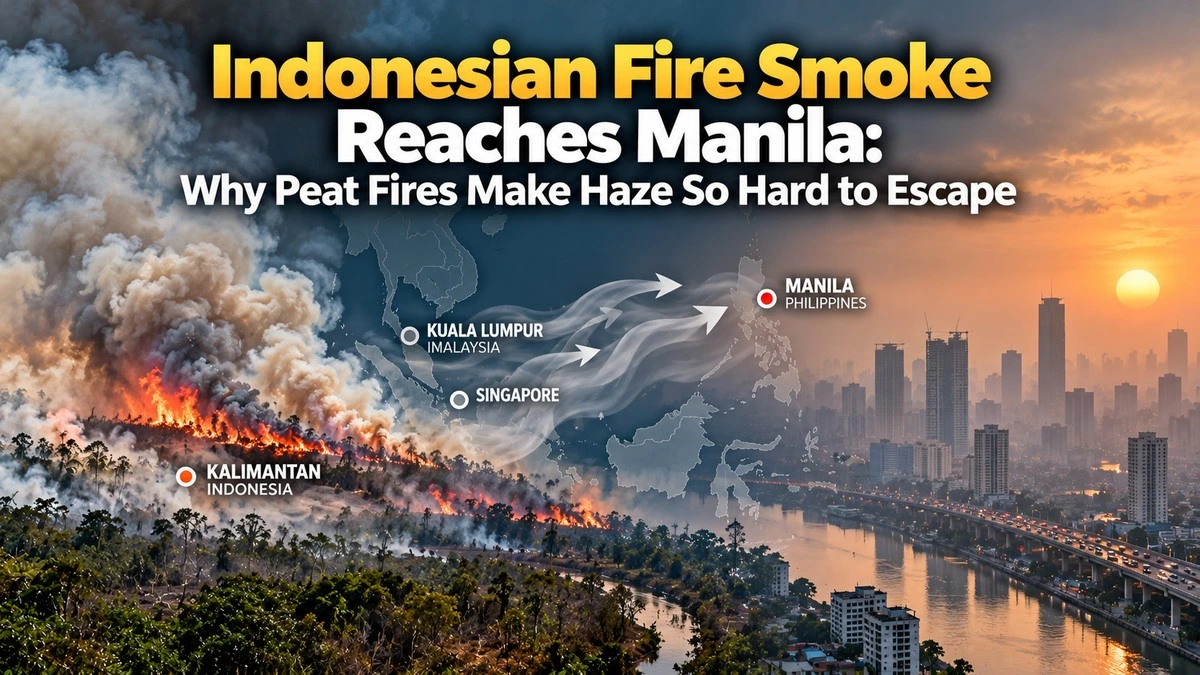
On October 4, haze settled over Manila, and air-quality stations across the city recorded readings in the “Fair to Unhealthy for Sensitive Groups” range. The likely source is more than a thousand kilometres away: peatland and forest fires burning in Indonesian Borneo. It’s a reminder that smoke doesn’t stop at borders.
By Dr. Lukas Müller, Ph.D. Atmospheric Sciences (Atmospheric Chemistry & Air Pollution). Researched and fact-checked against the primary sources listed below and reviewed by our editorial team. Last updated: October 6, 2026.
What’s happening
Indonesia is having one of its worst fire years in recent memory. The forestry ministry recorded more than 202,000 hectares burned between January and July 2026, roughly 69% more than a year earlier. Satellite estimates from the group Nusantara Atlas put the total far higher by late August, although counts differ depending on how burned land is measured, so treat any single total with care.
The haze has drifted across Malaysia, Singapore, Brunei, Thailand and now parts of the Philippines. Manila’s environmental department attributed the October 4 haze to smoke from fires in Kalimantan, carried by prevailing winds, and advised sensitive residents to limit time outdoors and wear masks when needed.
Why peat fires are so hard on lungs
Peat is essentially centuries of partly decayed plant matter, stored like a giant sponge of fuel. When drained and dried, it smoulders instead of flaming, and it can burn underground for weeks or months. Reporting by Down To Earth, citing researchers, notes peat fires release about three times more fine particles than typical tropical forest fires.
Those fine particles, known as PM2.5, are small enough to slip deep into the lungs and bloodstream. Think of them as dust finer than a strand of hair’s width many times over.
The El Niño factor
A strong El Niño has dried out the region. But experts are careful about blame: as one researcher quoted by Down To Earth put it, El Niño doesn’t ignite fires, it creates the dry conditions that let human-started fires escape. Land clearing by burning and drained peatlands are the sparks and the fuel. Authorities have revoked five company permits and frozen dozens more, and the president has ordered a new agency to manage peat and mangrove areas.
The human toll so far
- More than 12.5 million people were exposed to haze across seven Indonesian provinces.
- 113,336 people had been treated for respiratory problems by September 9, up from 50,891 on September 1.
- More than 1.4 million students were pushed into remote learning.
What this means for you
If you live in Southeast Asia, check a live PM2.5 reading before outdoor exercise, keep windows shut when the haze is thick, and use a well-fitted N95 or equivalent mask outdoors if readings are unhealthy. Children, older adults and people with asthma should be the first to cut back.
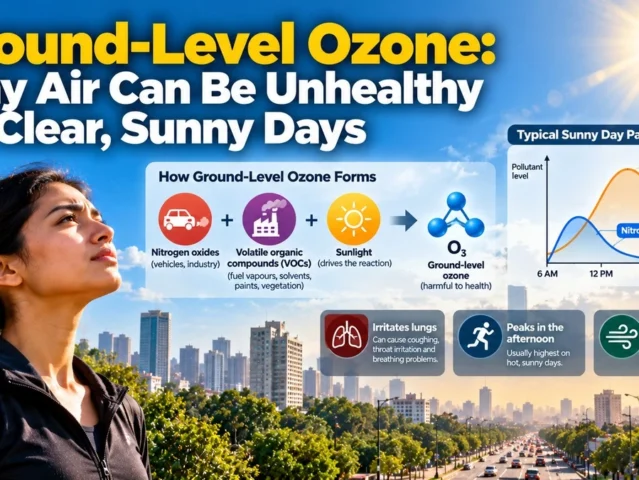
If you’re elsewhere, the lesson still applies. Smoke from big fires travels on the same winds that carry weather, so a distant fire can show up on your app within days. Our related piece on how wind and calm days shape smog explains the mechanics.
A chart worth watching
A simple line chart of Indonesia’s respiratory cases treated, plotted by week from September 1, would show how quickly the burden grew. A second map-style graphic marking Kalimantan, Singapore, Kuala Lumpur and Manila would make the haze’s reach obvious at a glance.
Bottom line
Fires in one country can become another country’s air-quality emergency. With El Niño forecast to last into early 2027, expect more haze alerts across the region until the rains arrive.
Related reading
- Ventilation index explained: why calm days trap smog
- PM2.5 vs PM10: what matters more for your health